
Attorney-General Michelle Rowland told Pauline Hanson to look at her own behaviour and her own party after Hanson said the prime minister’s Queensland speech put her under threat. That’s the fight this week. Not the Secret Harbour booth. The words.
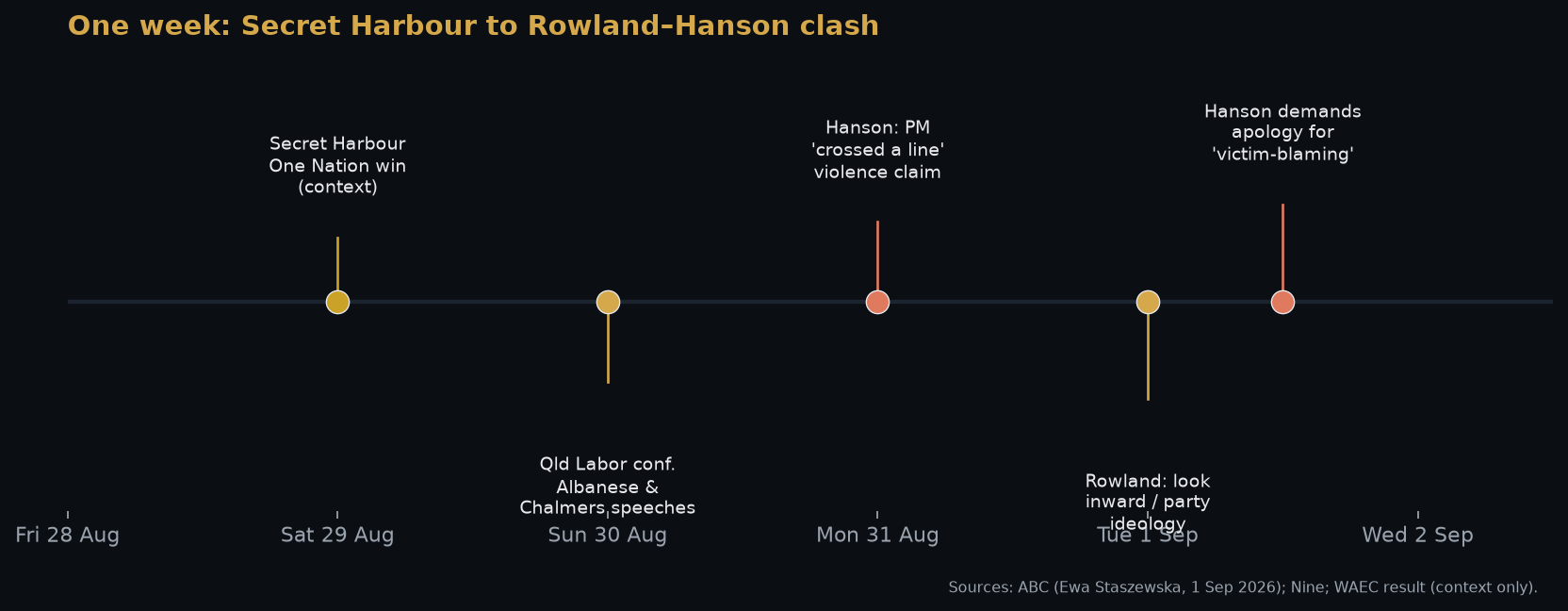
Here’s what happened. On Sunday, 30 August, Anthony Albanese and Jim Chalmers went after One Nation at the Queensland Labor conference in Brisbane. On Monday, Hanson said they’d crossed a line and that this is how political violence gets invited. On Tuesday, 1 September, Rowland told the ABC Hanson should examine her own standards, her ideology, and who she entertains. Hanson called that slanderous and demanded an apology. Angus Taylor said Albanese should be held to his own “divisive and dangerous” ledger. Deakin University’s Josh Roose called Hanson’s claim of special danger from the PM’s speech a step too far.
You might have missed the order of the days. The Secret Harbour by-election on Saturday, 29 August — One Nation’s Luke Herdegen taking Labor’s coastal seat south of Perth — is already on the record elsewhere on this desk. Treat it as the weekend that lit the fuse, not the story you’re reading now. The new news is the Albanese–Hanson–Rowland clash from Sunday through Tuesday.
What Albanese said in Brisbane
Albanese didn’t soft-pedal. At the Queensland Labor conference he framed hard-right populists as a global problem with a local name. ABC political reporter Ewa Staszewska filed the tape on Tuesday afternoon. The prime minister’s line, as she reported it:
“Across the world hard right populists are on the march. Peddling politics that is dangerous, divisive, and downright dishonest.”
Then the duty clause:
“We simply must defeat them. We owe it to history.”
And the charge sheet against parties like One Nation:
“They’ll say anything and do anything to win votes. Bend any facts. Peddle misinformation and disinformation. Turn Australian against Australian. Parties like One Nation have no serious answers to our problems.”
Nine’s Yashee Sharma had the same conference language overnight Monday. So did news.com.au. The words aren’t in dispute. The argument is what those words do once they leave the hall.
Albanese also used the conference to mark Labor as the last mainstream force he thinks still governs in the national interest. He criticised Hanson for past remarks that domestic violence is sometimes a woman’s fault, that Australia should be a monoculture, and that workers are lazy — lines Nine says Hanson has tried to walk back. That’s Labor’s contrast play: paint One Nation as unserious and corrosive, then claim the centre.
Why say it on that Sunday? Timing isn’t subtle. Secret Harbour had just delivered One Nation its first Western Australian lower-house seat the day before. Hanson had already warned federal Labor that more seats were coming. A Queensland hall full of Labor delegates is where a prime minister under pressure talks about history and defeat. You don’t need a leaked talking point to see the politics. The speech is the talking point.
Chalmers and the “coalition of chaos”
Treasurer Jim Chalmers spoke separately at the same conference. The Nightly and Region Canberra both carried the same construction. Chalmers cast One Nation not as a sideshow but as part of a three-party problem:
“The threat to our country and its cohesion, its people, and our economy [is] posed by a dangerous and divisive coalition of chaos – a three-ring circus of Liberals, Nationals, and One Nation.”
That’s the Treasurer’s frame. Liberals, Nationals, One Nation — one circus. He added a cost-of-living cut: the big fault line, he said, isn’t only centre-left versus extreme right. It’s between people who want to ease legitimate frustration and people who “picket them and prey on them, to politicise them and capitalise on them, while leaving our major challenges largely undisturbed.”
Hanson heard “threat” and “danger” and treated those nouns as the offence. In her Monday social posts she named both Albanese and Chalmers. She said Australians are entitled to vote One Nation without being told by the Prime Minister and the Treasurer that the choice itself is a danger to the nation. That’s her ballot-box answer to their cohesion answer.
Hanson’s Monday: “crossed a line”
Monday, 31 August. Hanson went public. Nine quoted her social post in full enough to get the spine of it:
“No matter how worried Jim and Albanese are about losing their jobs, telling Australians that their democratically elected opponents are ‘dangerous’ and a ‘threat to our country’ invites people to treat them as a threat.”
“Words have consequences. That is how political violence is incited.”
She added the Widdecombe reference — carefully, because the British case is still being reported as an alleged murder under counter-terror investigation. Hanson pointed to the death of British parliamentarian and Reform UK figure Ann Widdecombe, killed in her home, as a warning about political rhetoric. Australian outlets repeated her warning. They did not present a finished court finding. Neither will this page. The point for Australian readers is that Hanson reached for an overseas killing to argue that domestic rhetoric can travel into violence. Whether you buy that leap is the political fight. The fact of her saying it is on the record.
She also tried to flip the danger line back onto Labor:
“The real danger to Jim and Albanese is that the people of Australia are coming for their government at the ballot box.”
That’s the One Nation version of turn-down-the-temperature: vote us in, stop calling us a threat. She told ABC the same day that Albanese’s treatment made her feel unsafe, and that she now needs federal police protection when she’s out meeting people.
“What he’s doing is putting me in a position of threats against me now that I have to have federal police protection whenever I’m out here, meeting people,” she said.
“It’s a shame. He’s caused this. I don’t want it. I want to feel safe in my own country.”
The Australian Federal Police would not discuss her protection arrangements. “The AFP does not comment on the protection of Parliamentarians and High Office Holders,” a spokeswoman told ABC. So you get Hanson’s claim of protection, and you get AFP silence on the detail. Both are part of the Tuesday story.
Region Canberra carried more of her Monday language: disagreement and robust debate are “fundamental parts of our democracy,” she said, but “normalising and encouraging” potential incitements to violence is where she draws the line. “Jim Chalmers and Anthony Albanese crossed that line yesterday in their attacks on One Nation.” She told them to take their own advice and “turn the temperature down.”
Rowland on Tuesday: look inward
Attorney-General Michelle Rowland answered on Tuesday, 1 September — on ABC Radio National Breakfast and in follow-up clips Staszewska used for the evening piece. Rowland did two things at once. She agreed that high-profile women in politics are under more danger. Then she pointed the finger back at Hanson.
“I don’t wish any politician any ill will, irrespective of their political persuasion, but I think sometimes when comments like this are made, one needs to look at oneself and one’s behaviour and the kinds of standards that they accept into their own party and their own ideology,” Rowland said.
She went further on the company Hanson keeps:
“When you go on and you entertain some of the individuals whom she has been entertaining, who are not only convicted criminals, when you admit that you have a party that has been infiltrated by extremists and neo-Nazis, this is exactly the kind of danger to which politicians are being put in this country.”
On algorithms and hate, Rowland told RN Breakfast the feed problem is “completely unacceptable, and it is out of control,” hitting politicians “right across the aisle.” She still tied Hanson’s complaint back to Hanson’s own record: “I would suggest that Senator Hanson should examine what her party and what her ideology and her behaviour is doing, and whether or not that is encouraging that.”
Nine’s Tuesday write-up filled in the recent examples Rowland’s camp wants voters to remember. A neo-Nazi protester crashed a One Nation fundraiser in Melbourne in June with a “heil Pauline Hanson” shout while being handcuffed — Hanson tried to distance herself at the time. In July, Hanson confronted people in Luton, Britain, alongside Tommy Robinson, whom Nine describes as a convicted criminal and Islamophobic agitator. Last week, One Nation senator Malcolm Roberts defended free-speech grounds for White Australia, the country’s main neo-Nazi group, as Nine summarised it. Rowland didn’t invent a vacuum. She argued Hanson’s orbit is part of the threat environment Hanson now cites.
Hanson’s apology demand
Hanson’s Tuesday reply was fast. On social media she called Rowland’s comments slanderous and demanded an apology. ABC quoted the first-law-officer line:
“No minister, especially the Attorney-General and first law officer of the country, should suggest there is any justification for threats against Australians because of the political party they support.”
Nine had the fuller statement language:
“Millions of Australians support One Nation. They are not extremists. They are not dangerous. And ministers should not use language that encourages others to treat them as if they are.”
She framed Rowland’s remarks as “victim-blaming.” That’s a deliberate phrase. It turns a dispute about party standards into a dispute about whether a threatened politician is being told she asked for it. Labor hears a refusal to own extremist adjacency. Hanson hears a minister excusing threats against her voters. Both sides are talking to their bases. You’re hearing both because the Attorney-General and the One Nation leader made sure you would.
Nine also noted a Perth man currently before the courts over an alleged threat to kill Hanson, and a broader charge sheet: nearly 40 people charged for alleged threats against parliamentarians in the last 12 months, plus about 20 before the courts for alleged threats against the prime minister. Those numbers sit beside Hanson’s protection claim. They don’t prove Albanese’s Sunday speech caused any particular threat. They do prove the threat climate is real enough for police work.
Taylor sides with accountability for Albanese
Opposition Leader Angus Taylor was asked about the prime minister’s comments. He didn’t defend One Nation’s full programme. He did refuse to let Albanese own the word “dangerous” alone.
Albanese, Taylor said, must be held accountable for his own “divisive and dangerous” behaviour.
“He divided Australians by race on the Voice, and what he has failed to do on many things, including with Islamic extremism, is he has failed to deal with dangerous situations,” Taylor said, as ABC reported it.
That’s the Coalition angle this week: if Labor wants a danger debate, bring the Voice referendum and Islamist extremism into the same room. It lets Taylor criticise Albanese without embracing Hanson’s violence claim wholesale. It also keeps the Liberals in a story that, for months, has been running through One Nation’s polling surge more than through Coalition recovery.
Josh Roose: “disingenuous”
Associate professor Josh Roose, a Deakin University specialist on political violence and extremism, gave ABC the expert cut. He said alleging Albanese’s speech was particularly dangerous or divisive was a “step too far.” He also said threats against politicians are at an “all-time high.”
“There should be zero tolerance for threats or violence against elected politicians,” Roose said.
“However, weaponising statements that clearly aren’t necessarily intended to incite violence and claiming victimhood … is disingenuous.”
He argued Hanson looked to be claiming victimhood as political capital, and that she was in no position to take the higher moral ground. He pointed to her burqa stunt in parliament as a temperature-raising move, and said her rhetoric is “divisive and designed to speak directly to her potential constituency.”
ABC’s same piece listed the recent record Roose’s critique sits on: Hanson was found in 2024 to have breached the Racial Discrimination Act over a social media post telling Greens senator Mehreen Faruqi to “piss off back to Pakistan.” One Nation MP Malcolm Roberts has pushed false and divisive claims, including that COVID-19 vaccination dramatically increased miscarriage rates, and drew criticism for sharing an antisemitic mural he called “the most powerful pic I’ve ever seen.” Last weekend Hanson put a nail into a prop coffin labelled net zero at a farmer rally in regional Victoria and later buried it — theatre, not a policy white paper.
Roose’s line doesn’t clear Labor of hard language. It says Hanson’s specific claim — that this speech is how you get political violence — overreaches. You can hold both ideas: threats are up, and a conference speech calling a rival party dishonest is not automatically an incitement.
The threat numbers behind the argument
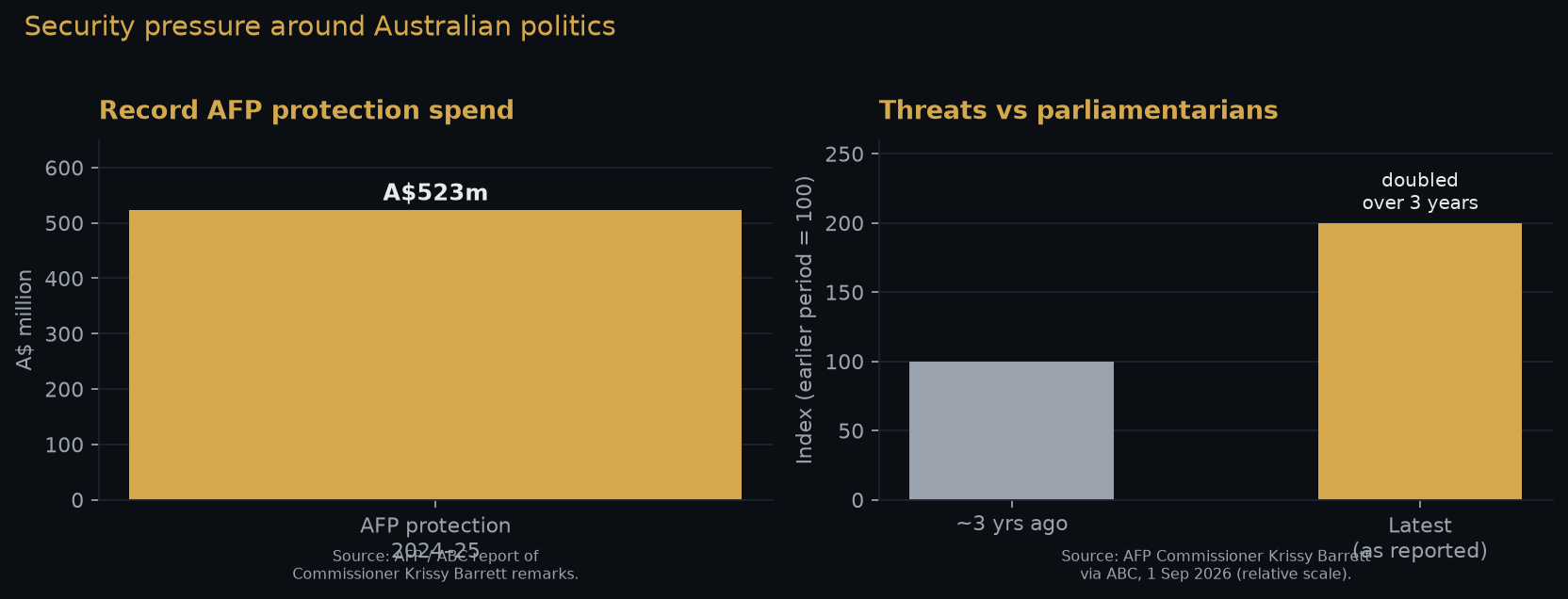
Strip the partisan theatre and you’re left with a security spreadsheet. ASIO director-general Mike Burgess has previously warned that politically motivated violence is “flashing red.” A 2025 survey of federal politicians and their staff found 85 percent had dealt with constituents behaving in a violent, threatening or volatile way. Last year the AFP stood up specialised strike teams aimed at extremist activity and the rise in political violence.
AFP Commissioner Krissy Barrett said threats against parliamentarians had doubled over the past three years. The AFP spent a record A$523 million protecting politicians and government buildings in 2024–25. “Through the election period that was an enormous exercise for the AFP and a huge responsibility to protect parliamentarians and that was a success,” she said in October. “But the volume of threats remains concerning.”
In 2024 police thwarted an alleged attempt to kill a NSW Labor MP. In June this year, Liberal frontbencher Andrew Hastie was identified for security upgrades at his home and electorate office. Albanese has repeatedly told politicians and the public to “turn the temperature down.” That phrase is now a weapon both sides swing. Hanson says Labor ignored its own advice. Labor says Hanson’s politics is the heat.
None of those figures require you to pick a tribe. They’re why Rowland can say it’s dangerous to be a high-profile woman in politics and still land a punch on Hanson in the same breath. The ambient risk is bipartisan. The blame game is not.
Secret Harbour, briefly, because it started the week
If you need the booth context in one place: Saturday, 29 August, Secret Harbour, Western Australia. Luke Herdegen, a gym owner, became One Nation’s first WA lower-house MP. Labor’s Georgia Tree conceded Sunday. Nine’s Monday report had Herdegen on 39.08 percent of the primary, Tree on 24.43 percent, Liberal Ryan Robertson on 17.29 percent. Liberal preferences helped. Federal Liberals grumbled about the state party’s preference choice. Hanson said she was coming for more seats. We’ve filed the long Secret Harbour count separately. This piece won’t re-run it. It matters here only because Albanese and Chalmers spoke into that result the next morning.
Federal senator Murray Watt told Nine’s Today not to over-read a state by-election that wouldn’t change who governs in Perth. “Especially one that wasn’t going to change the result in terms of who was going to be in government. But we’ve said all along that we take this challenge seriously,” he said. That’s the calm line. The Queensland conference was the loud line.
Polls already on the table — no new inventions
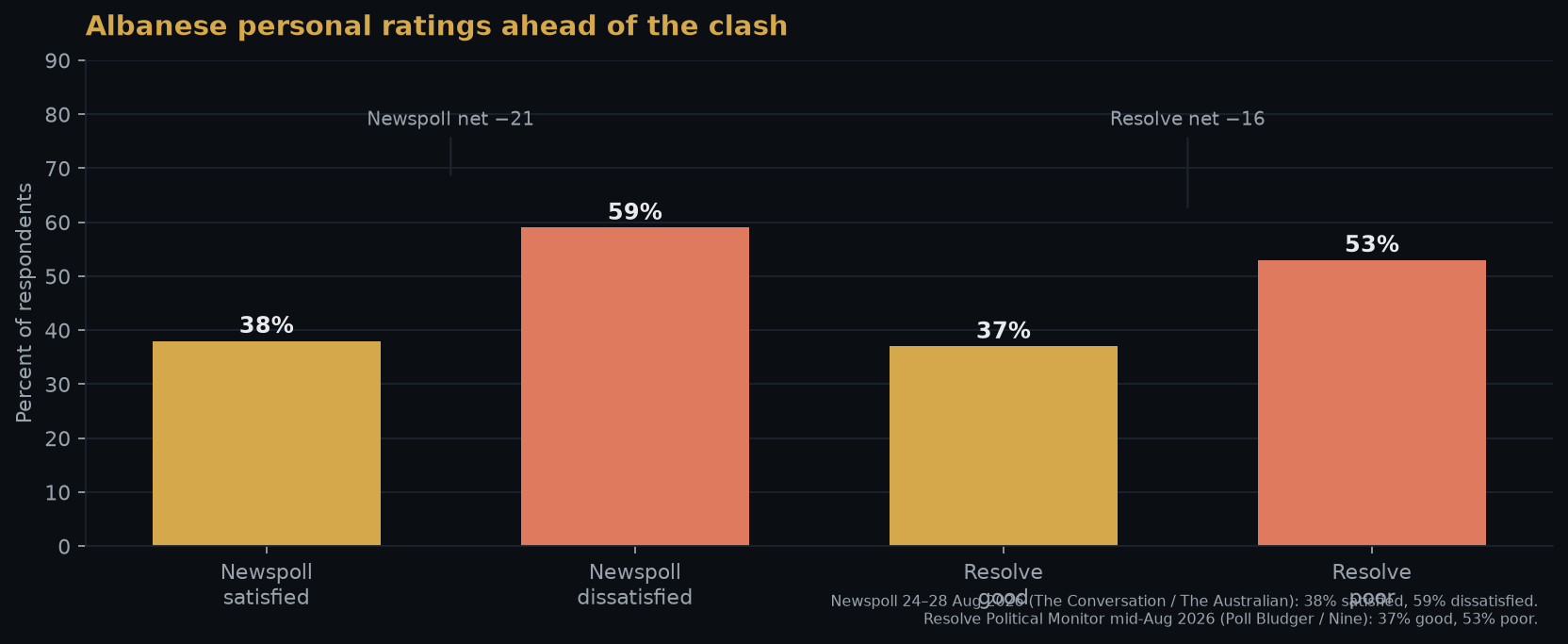
You don’t need a fresh poll invented for this paragraph. The Conversation’s late-August Newspoll wrap, fielded 24–28 August from a sample of 1,243, had Albanese’s net approval at −21 — 38 percent satisfied, 59 percent dissatisfied — continuing a streak of Newspoll nets at or below −15 since late February. One Nation’s primary in that Newspoll sat at 30 percent, Labor 29, Coalition 19, Greens 13. Pauline Hanson’s own net in Newspoll was −1 (47 satisfied, 48 dissatisfied). Angus Taylor’s net was −17.
Resolve Political Monitor, mid-August for Nine, had Albanese at 37 percent good and 53 percent poor on Poll Bludger’s read — a net around −16. Preferred prime minister in that Resolve: Albanese 32, Hanson 26, Taylor 19. An AFR/Redbridge figure Nine cited around the by-election weekend had One Nation’s national primary easing three points to 28 percent, with Labor on 29 and the Coalition on 22, and preferred PM Albanese 31, Hanson 24, Taylor 15. Roy Morgan, on 1 September, flagged that its next poll would test the impact of Albanese’s attack and Hanson’s “inciting violence” reply. The numbers already in circulation explain why Labor chose the hard language and why Hanson chose the victim frame. Both are fighting over the same crowded right-of-centre lane.
One Nation has also claimed millions raised from a “fire the liar” fundraising drive aimed at Albanese — a party claim Guardian analysis noted while warning Labor that a prolonged slanging match with Hanson is mostly downside for the government. Fundraising claims are party claims until an audited figure lands. The political use is obvious: Hanson wants the fight televised.
What Labor thinks it’s doing
Labor’s theory is straightforward. Name One Nation as dishonest and dangerous. Tie the Coalition to it as a chaos package. Dare soft Liberal voters and soft Labor voters to see Hanson as a governing risk, not a protest valve. Chalmers’ “three-ring circus” line is the coalition-of-chaos update for a year when One Nation’s primary has sat near or above the Coalition in several polls.
Albanese’s “we owe it to history” is meant to sound bigger than a by-election hangover. It casts defeating hard-right populism as a generational job. That’s why Hanson called it crossing a line. If your voters just took a Labor seat in WA, being told you’re a historical menace isn’t a policy rebuttal. It’s a moral one. Moral fights raise money and raise temperatures. Labor knows that. So does Hanson.
There’s also a defensive read. A prime minister on a −21 Newspoll net can’t ignore a party polling in the high twenties. Ignoring it looks weak. Engaging it looks panicked. Albanese chose engage. Rowland’s Tuesday intervention doubles down: don’t just attack Hanson’s platform, attack her judgment about who sits in her party room orbit.
What Hanson thinks she’s doing
Hanson’s theory is just as clear. Treat Labor’s adjectives — dangerous, threat, dishonest — as proof the establishment fears the ballot box. Convert security fear into sympathy. Demand the Attorney-General apologise, which keeps the story alive another news cycle. Reference Widdecombe to internationalise the stakes. Tell supporters they’re “millions of Australians,” not extremists.
Does that require inventing a threat climate? No. The AFP and ASIO numbers are ugly enough without help. Hanson’s move is to assign cause: Albanese’s speech, she says, puts her under threat. Roose calls that assignment disingenuous. Rowland calls the complaint a mirror Hanson won’t face. Hanson calls Rowland’s mirror victim-blaming. You’re watching three different causal stories about the same threat data.
There’s also a tactical reason Hanson wants Albanese in the mud. Guardian analysis this week argued Albanese has more to lose in a prolonged personal fight with Hanson than she does. She thrives on the oxygen. He needs to look like a prime minister, not a combatant in a minor-party flame war. That’s why the Queensland hall speech was a choice with a cost. Labor made it anyway.
The Coalition’s awkward middle
Taylor’s comments put the Liberals where they’ve been for months: condemning Albanese’s divisiveness while watching One Nation eat into the right-of-centre primary. Federal Liberals criticised WA Liberals for preferencing One Nation in Secret Harbour. Andrew Hastie warned that in his Canning seat, dividing the right risked Labor. The preference fight and the rhetoric fight are cousins. Both ask whether One Nation is a competitor, a partner, or a contagion.
Taylor’s Voice and Islamic-extremism counter doesn’t resolve that. It changes the subject to Labor failure. Useful in a press doorstop. Less useful if your state colleagues are handing One Nation a preference gift while your federal colleagues call the same party a problem. The chaos circus Chalmers described is partly a Liberal management failure. Taylor won’t say that sentence. Chalmers will.
Female politicians and the shared risk
Rowland’s sharpest honest line might be the one that isn’t aimed only at Hanson: it is increasingly dangerous to be a high-profile female politician in Australia. Hanson says she feels that danger. Rowland says she feels the algorithm problem too. The disagreement is about cause and remedy.
Remedy, for Rowland: raise party standards, stop entertaining convicted criminals and extremist infiltrators, stop feeding the atmosphere you then cite. Remedy, for Hanson: stop ministers branding millions of voters a national threat. Remedy, for Roose: zero tolerance for threats, and don’t pretend a conference denunciation is the same thing as a hit list. Remedy, for the AFP: strike teams, protection spend, and a refusal to discuss individual arrangements on the record.
If you vote, you don’t get to opt out of this climate. The 85 percent survey figure means most federal offices already live with volatile constituents. The doubled-threat line means the curve isn’t flattening. The A$523 million protection bill is what “flashing red” costs in a budget year. Rhetoric sits on top of that hardware. It doesn’t invent it.
Ballot box versus street temperature
Here’s the clean split for readers who don’t care about conference choreography. One Nation wants this treated as a democratic legitimacy fight: you may dislike us, you may not tell the country we’re a threat. Labor wants it treated as a democratic responsibility fight: parties that flirt with extremist adjacency don’t get to claim clean hands when the temperature rises. The Coalition wants Albanese’s own divisiveness on the charge sheet. The security agencies want fewer threats, full stop.
Those aren’t the same argument. Confusing them is how a by-election hangover becomes a week-long accusation of incitement.
Hanson says words have consequences. She’s right about the general rule. The contested claim is the particular one: that Albanese’s “dangerous, divisive and downright dishonest” formulation, and Chalmers’ “threat to our country and its cohesion,” amount to inciting political violence against her and her voters. Labor rejects that. Roose calls it a step too far. Rowland says look at Hanson’s own guest list and ideology. Taylor says hold Albanese accountable for other dangerous failures. The AFP won’t confirm Hanson’s protection detail. The threat statistics keep climbing anyway.
Secret Harbour put One Nation on a WA lower-house bench. Brisbane put Labor’s adjectives on the record. Monday put Hanson’s violence claim on the record. Tuesday put Rowland’s inward look and Hanson’s apology demand on the record. That’s the sequence. The booth result is context. The rhetoric clash is the news.
Will an apology arrive? Rowland showed no sign of offering one on Tuesday. Will Albanese soften the hard-right language? The Queensland speech was built for the opposite. Will threats against parliamentarians fall because two parties argued about adjectives for 48 hours? The AFP’s own numbers say the problem is bigger than one conference. You can follow the quotes without pretending a Facebook fight is a security plan.
For now, the Attorney-General has told the One Nation leader to look inward. The One Nation leader has told the Attorney-General to apologise. The prime minister has told Labor it owes history a defeat of hard-right populists. The Treasurer has called the other side a three-ring circus. The opposition leader has put Albanese’s name next to the word dangerous. An extremism scholar has called Hanson’s victim claim disingenuous. And the protection bill for Australian politics sits, for the last reported year, at A$523 million.
How the conference speech was built to travel
Conference speeches are designed to leave the room. Albanese’s Queensland address did that job. The “dangerous, divisive and downright dishonest” triad is sticky because it alliterates and because it names a category — hard-right populists — before it names a party. One Nation is the local instance of a global type, in Labor’s telling. That lets the prime minister talk about Europe and America and still land the punch in Brisbane.
“We simply must defeat them. We owe it to history,” is the sentence Hanson treated as escalation. Defeat is ordinary campaign language. Owe it to history is not. It casts the opponent as a civilisational problem. You can agree with Labor’s policy case against One Nation and still see why Hanson called that a line-cross. You can agree with Hanson’s right to exist as a party and still reject her claim that the sentence equals incitement. Those are separate judgments. This week’s coverage often mashed them together.
Chalmers’ “three-ring circus” did a different job. It wasn’t only about Hanson. It was about binding Liberals and Nationals to One Nation as a governing alternative Labor wants voters to fear. In a year when One Nation’s primary has repeatedly printed near or above the Coalition’s in major polls, that binding is strategy, not poetry. If soft Coalition voters hear “circus,” Labor hopes they stay home or stay with Labor. If One Nation voters hear “circus,” Hanson hopes they dig in. Both outcomes can be true in different booths.
What “turn the temperature down” means after this week
Albanese has used the temperature line for months. Hanson threw it back. Rowland effectively said Hanson’s own thermostat is the problem. Roose said don’t confuse denunciation with incitement. Barrett’s AFP numbers say the mercury is up regardless of who wins the metaphor.
Temperature is a soft word for a hard problem. An 85 percent survey of violent or volatile constituent behaviour is not a vibe. A doubled threat count over three years is not a vibe. A$523 million in protection spend is not a vibe. When politicians argue about adjectives while those figures sit in the same ABC story, readers are entitled to ask which part of the argument changes the spreadsheet. Tuesday’s exchange did not announce a new offence, a new AFP power, or a new parliamentary security standard. It announced a fight about blame.
That doesn’t make the fight fake. Blame fights decide who gets to speak as the adult. Labor wants to own the adult voice against populism. Hanson wants to own the adult voice against elite contempt for her voters. Taylor wants to own the adult voice against Albanese’s divisiveness without surrendering the right flank. Roose, as the outside expert, tried to keep a lane for zero-tolerance security that doesn’t require accepting Hanson’s causal story about Sunday’s speech.
Extremist adjacency is the real subtext
Rowland’s convicted-criminals and neo-Nazis line is the subtext that keeps this from being a pure free-speech spat. Nine’s reporting this week connected the dots Labor wants connected: the Melbourne fundraiser crash, the Luton appearance with Tommy Robinson, Roberts’ free-speech defence around White Australia. Hanson rejects the smear and says millions of One Nation voters are not extremists. Both statements can be partially true. A party can have a mass electoral base and still have an extremist-adjacency problem. Rowland is arguing the second. Hanson is defending the first. The Tuesday apology demand tries to make any mention of the second into an attack on the first.
ABC’s reminder of the Faruqi Racial Discrimination Act finding, Roberts’ vaccine miscarriage claims, and the antisemitic mural share sits in the same bucket. So does the net-zero coffin stunt at the Victorian farmer rally. Stunts and court findings aren’t the same as street violence. Roose’s point is that Hanson has spent years raising political temperature for attention, which weakens a sudden claim of unique victimhood when the PM answers in kind. You don’t have to like Albanese’s adjectives to follow that logic.
Hanson’s counter-logic is simpler and polls well with her base: if ministers call your party a threat to the country, some listeners will treat your members as threats. Words have consequences. That general rule is why newsrooms quote her carefully and why ASIO talks about flashing red. The specific leap — from Sunday’s conference rhetoric to Monday’s protection claim as cause and effect — is where Roose says she goes too far.
What readers should watch next
Three things matter more than the next social post. First, whether Labor keeps the hard-right framing as a standing line or treats Queensland as a one-off vent after Secret Harbour. Second, whether the AFP or state police announce any new threat pattern tied to this week’s coverage — they usually won’t discuss it, but charge numbers and protection upgrades still leak into public reporting, as Hastie’s June upgrades did. Third, whether Coalition state branches keep preferencing One Nation while federal Liberals complain about the split right. Secret Harbour made that contradiction concrete. This week’s rhetoric fight doesn’t resolve it.
Also watch the fundraising. One Nation’s “fire the liar” pitch, with its claim of millions raised against Albanese, turns every Labor insult into a donation email. Guardian analysis flagged that dynamic while warning Albanese that extended personal combat with Hanson is structurally unwise for a prime minister. If the apology demand runs for days, that is not an accident. It is a business model wearing a grievance.
Roy Morgan has already told clients its next update will measure the Albanese attack and Hanson’s violence reply. Newspoll and Resolve will do the same on their cycles. If you’re tempted to treat Tuesday’s quotes as a final verdict, wait for the next sample. Polls don’t settle moral arguments. They do tell you whether Labor’s history-debt language and Hanson’s victim language are working on the only audience that counts in a democracy.
That’s the week after Secret Harbour. The seat changed on Saturday. The language hardened on Sunday. The violence argument landed on Monday. The inward look — and the apology demand — landed on Tuesday. If you’re keeping score at home, keep the days straight. The story isn’t who won a coastal by-election. You already know that. The story is what Australia’s leaders chose to say to each other once the booths closed, and what they accuse those words of doing once they leave the hall.
The paper
Comments
No notes on this story yet.
Sign in to comment