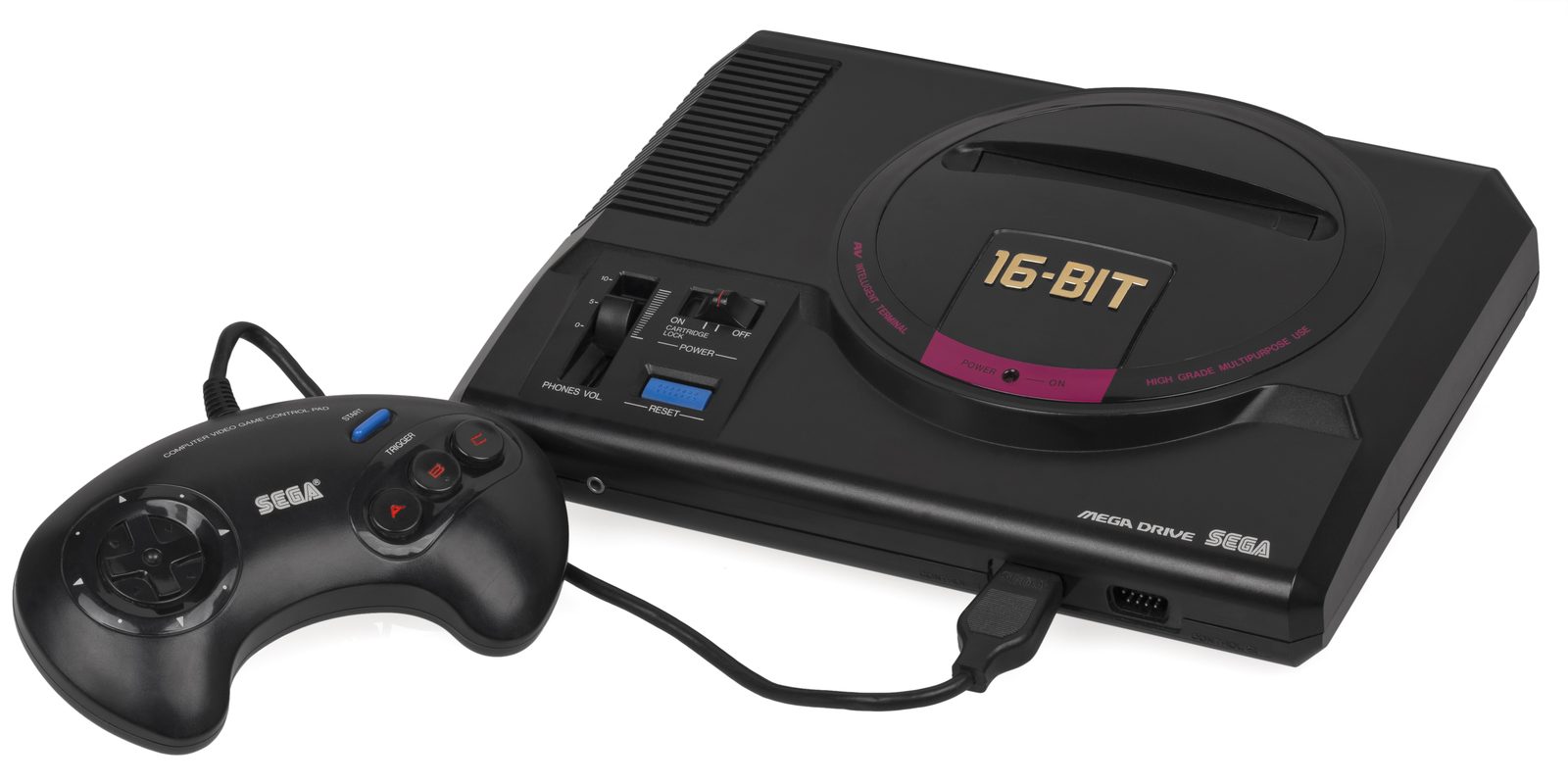
A black wedge. That’s the machine Sega put in Japanese shops on Saturday 29 October 1988. The manufacturer is Sega. The name on the Japanese lid is Mega Drive. Sega’s own hardware encyclopaedia lists the original model as HAA-2500, 280 millimetres wide, 212 millimetres deep and 70 millimetres high, drawing about 13 watts from a dedicated 9-volt adapter. Inside: a Motorola 68000 clocked at 7.67 MHz, a Zilog Z80A at 3.58 MHz, 64 KB of work RAM for the 68000, 8 KB for the Z80, and 64 KB of video RAM. Sound is a Yamaha YM2612 FM chip plus a Texas Instruments SN76489 programmable sound generator. The games are ROM cartridges. They drop into a slot on the top. The Japanese launch price was ¥21,000.
This is a review of that wedge, not of a hedgehog. The short version is: Sega took the architecture of its System 16 arcade board, put a 16-bit home CPU in a case that looks like a cassette deck, and spent a decade arguing with Nintendo about who owned the living room. The object on the table is still the same object. Plastic. A gold 16-BIT badge on the Japanese lid. Two controller ports on the front. A reset. A power lamp. On the first model, a headphone jack, because the 8-pin DIN video socket on the back of that revision carried mono.
Here’s what happened. Sega’s console R&D team, led by Masami Ishikawa and supervised by Hideki Sato, started the successor to the Master System almost as soon as that 8-bit machine shipped. NEC had already made a noise in Japan with the PC Engine. The team adapted System 16. They chose the 68000 late. They kept a Z80 as a sound CPU because they did not want the main processor carrying the picture and the audio at once. Mitsushige Shiraiwa’s design group looked at hi-fi and cars. Sato later said the Japanese shape was based on an audio player, with the 16-bit wording in a gold metallic veneer. Sega tried the name Mark V in Beep! in June 1988, then picked Mega Drive from more than 300 proposals.
29 October 1988. Nintendo had shipped Super Mario Bros. 3 a week earlier, so the launch did not own the week. Famitsu and Beep! were kind. The first production run sold out in two days. Sega still only shipped about 400,000 units in Japan in the first year. The Mega Drive stayed third at home, behind Nintendo’s Super Famicom and NEC’s PC Engine, for the rest of the 16-bit years. Japan is not where this wedge won.
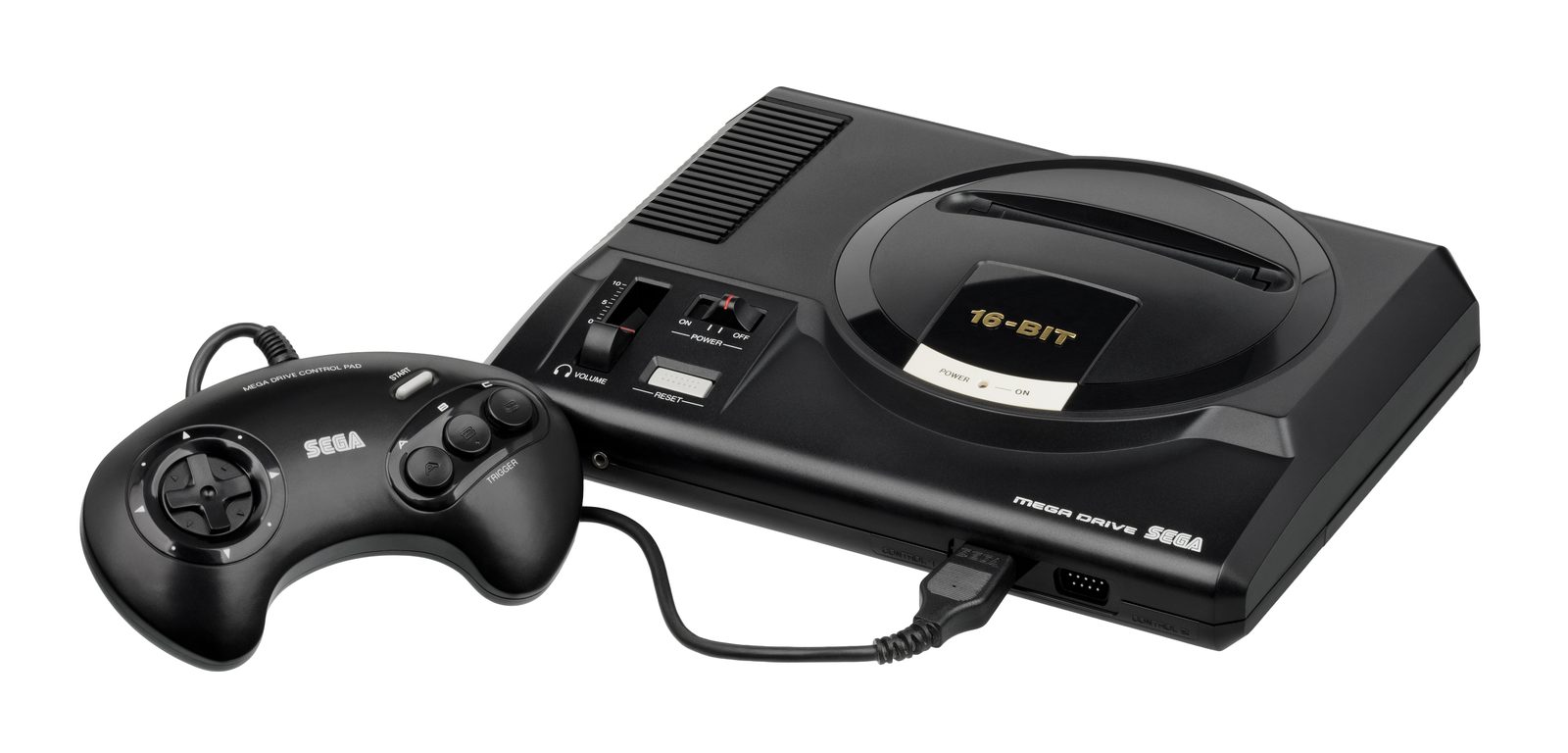
You might have missed this part. North America did not get a Mega Drive. It got a Genesis. Sega of America launched the machine itself after Atari Corporation declined to take it. David Rosen, who had co-founded Sega, pushed the new name; he did not like Mega Drive and wanted the American box to mean a new beginning. The official North American launch was September 1989, with a handful of units on retailer shelves in New York and Los Angeles in late August. Game databases pin those two-city shelves to 14 August 1989. A Daily News advertisement on 27 August 1989 was already selling the 16-bit set at Nobody Beats the Wiz in New York, with Super Thunder Blade, Space Harrier II, Last Battle and Tommy Lasorda Baseball on the same page. The suggested US price was US$189. The pack-in was Altered Beast. The nationwide run followed in September.
The clock is the sentence marketing later tried to shout over. Sega’s published Japanese spec is 7.67 MHz for the 68000. Some listings round the same chip to 7.6 MHz. The NTSC machine derives that rate from a 53.693175 MHz master crystal divided by seven, which lands at about 7.67 MHz. PAL boards are specified a hair slower. Neither published number is a mystery. Neither number is “blast processing.” Blast processing was a slogan Sega of America coined in the Super NES years. Former Sega of America technical director Scot Bayless later described the origin: he had mentioned blasting data into the digital-to-analogue converters, the publicity office liked the word blast, and the campaign was born. The silicon did not get faster because a commercial said it did. The 68000 is still a 68000. The Z80 is still a Z80. You can measure it with a probe.
What the board actually does is more useful than the slogan. The Video Display Processor talks in tiles and sprites. Sega’s Japanese spec sheet lists 64 colours on screen from a 512-colour palette, 80 sprites, and two scrolling planes. Typical NTSC output is 320×224 or 256×224; PAL adds 240-line modes. Interlace exists if a title asks for it. The YM2612 gives six FM channels, one of which can be used as PCM. The SN76489 adds three pulse channels and a noise channel. The Z80 is there to drive both chips so the 68000 is not doing the mix. On the original Model 1, stereo comes out of the front headphone jack. The RF socket and the DIN on the back are mono. That is an engineering limit, not a character flaw. If you wanted two channels in 1989 you plugged headphones into the wedge, or you waited for the Model 2’s mini-DIN, which carried stereo with the picture.
Europe arrived in September 1990. Virgin Mastertronic handled it, at £189.99, with Altered Beast in the box and Space Harrier II, Ghouls ’n Ghosts, Golden Axe, Super Thunder Blade and The Revenge of Shinobi on the launch shelves. Sega bought Virgin Mastertronic in 1991 and that office became Sega of Europe. Australia ran through Ozisoft, the same distributor that had already done the Master System. The Australasian Mega Drive is 1990. PAL listings put it in September. Tectoy put a Mega Drive into Brazil on 1 September 1990. Samsung sold it in Korea from August 1990 as the Super Gam*Boy, later the Super Aladdin Boy. The plastic is the same idea in every market: a low black wedge, cartridge in the top, two pads on the front.
The pad that shipped with the first machines has a directional disc, three face buttons and Start. In 1993 Sega issued a six-button pad, smaller, with three extra faces, because fighting games had made six buttons the arcade default. Two controller ports are on the console. Electronic Arts later sold a 4 Way Play multitap; Sega sold a Team Player. Codemasters put extra ports on a few cartridges and called the trick J-Cart. The Power Base Converter — Mega Adaptor in Japan, Master System Converter in Europe — sits on the cartridge slot and plays Master System games. It is a pass-through, not a new computer. The original converter is built around the Model 1’s bulk. On a Model 2 it blocks the power inlet unless you modify the shell or use a pass-through. That is geometry, not a dunk.
In 1993 Sega cut the wedge down. The Mega Drive II in Japan, Europe and Australia, sold in North America simply as Genesis, is a smaller, lighter board in a smaller, lighter case. The headphone jack goes. The 8-pin DIN and the RF socket go. In their place: a 9-pin mini-DIN that carries composite, RGB and stereo, plus a standard RF switch. The power draw drops because the board is simpler. Same 68000. Same library. Same top slot. The object got cheaper to make. The object did not become a different generation.
Two add-ons tried to extend the same slot. The Mega-CD shipped in Japan on 12 December 1991 at ¥49,800; North America got it on 15 October 1992 as the Sega CD at US$299; Europe followed in 1993. A second processor, more RAM, a CD-ROM drive, hardware scale and rotate, battery-backed save RAM. Sega sold 2.24 million of them. The 32X arrived in November 1994 with two Hitachi SH-2 chips, a pass-through cartridge slot, and a promise that this was the cheap door into 32-bit. Sega sold about 800,000. Neither add-on is a failure of the wedge. They are extra boxes that plug into a 16-bit machine whose main CPU is still 7.67 MHz. Hardware fragmentation is what you get when you stack peripherals on a living product. The original console did not need them to be a console.
The library is why the plastic lasted. Altered Beast was the first pack-in. Sonic the Hedgehog replaced it in 1991. Sega of America, under Tom Kalinske from mid-1990, cut the US price, built an American sports list, and put Sonic in the box. Electronic Arts signed a licence in June 1990 after a clean-room reverse-engineering effort and put John Madden Football on the machine before the year was out. Sega’s Japanese side kept feeding arcade ports. Capcom’s Street Fighter II: Champion Edition sold more than a million on this hardware. The cartridge is still a ROM sitting in 64 KB of work RAM’s shadow. The 68000 still draws the frame. Nothing about that sentence changed because a commercial ran.
Sega’s own published total is 30.75 million Genesis and Mega Drive units. Of those, 3.58 million were Japan. As of June 1997, when Sega had stopped making the machine, Europe is roughly 8 million and the United States about 18 to 18.5 million. Tectoy later estimated 3 million licensed Brazilian variants. Majesco licensed a cheap Genesis 3 for North America in 1998. Those later shells are not this review. This review is the first wedge: 280 by 212 by 70 millimetres, gold badge, top slot, 7.67 MHz.
So. You put a cartridge in the roof. You press power. The 68000 starts. The Z80 waits for a sound command. The VDP fills a 512-colour palette and puts 64 of those colours on a 320-wide line. The YM2612 does the tune. If you are on a Model 1 and you want stereo, you use the front jack. If you are in Australia in 1990, the lid says Mega Drive and Ozisoft’s name is on the carton. If you are in Los Angeles in late August 1989, the lid says Genesis and the pack-in is Altered Beast. Same Motorola. Same Yamaha. Same black wedge. The marketing said blast. The crystal said 7.67. The crystal was telling the truth.
The paper
Comments
No notes on this story yet.
Sign in to comment