
Here's what happened. Atari, Inc. put a wood-grain Video Computer System on American shelves in 1977, with Combat in the box, two joysticks, a pair of paddles, and nine games on 2 KB cartridges. The company showed the unit at the Summer Consumer Electronics Show on 4 June 1977. Newspaper ads started in August. Nobody will give you a single street date, and that is the honest version: the exact day the first deck hit a counter is not in the surviving shipping record, and it may have been as early as August or as late as October. AtariAge records 11 September 1977 at Macy's and Sears. Weekly Television Digest, 17 October 1977, said 90,000 units had been shipped to all major market areas in the past two and a half months. Nick Montfort and Ian Bogost, in Racing the Beam, write that the VCS was not sold until October. I am not going to pretend those four sentences are the same sentence.
The short version is the object. A long black slab, wood-grain strip across the front, six silver switches on the first run, a cartridge slot in the middle labelled Video Computer System. Later four switches. Later no wood at all. Later a machine Atari Corporation sold as the 2600 Jr. for under US$50. The MOS 6507 inside does not change. One hundred and twenty-eight bytes of RAM does not change. The Television Interface Adaptor does not change. You are looking at a living-room radio that learned to hold a cartridge.
Cyan Engineering in Grass Valley, California, did the prototype work. Steve Mayer and Ron Milner had already been thinking about a programmable home machine when MOS Technology put the 6502 on a table at Wescon in September 1975 for US$25. Chuck Peddle's team offered them the cheaper 6507 — same silicon, fewer address pins, thirteen instead of sixteen — and the RIOT input/output chip, US$12 the pair. Joe Decuir, hired that December, debugged the first prototype and named it Stella after his bicycle. Jay Miner designed the TIA, the chip that actually talks to a television. Warner Communications bought Atari in October 1976 for US$28 million and put in the money to finish the thing. Fairchild's Channel F had already shipped a cartridge console in 1976. Atari's answer was cheaper silicon and a wood-grain bezel.
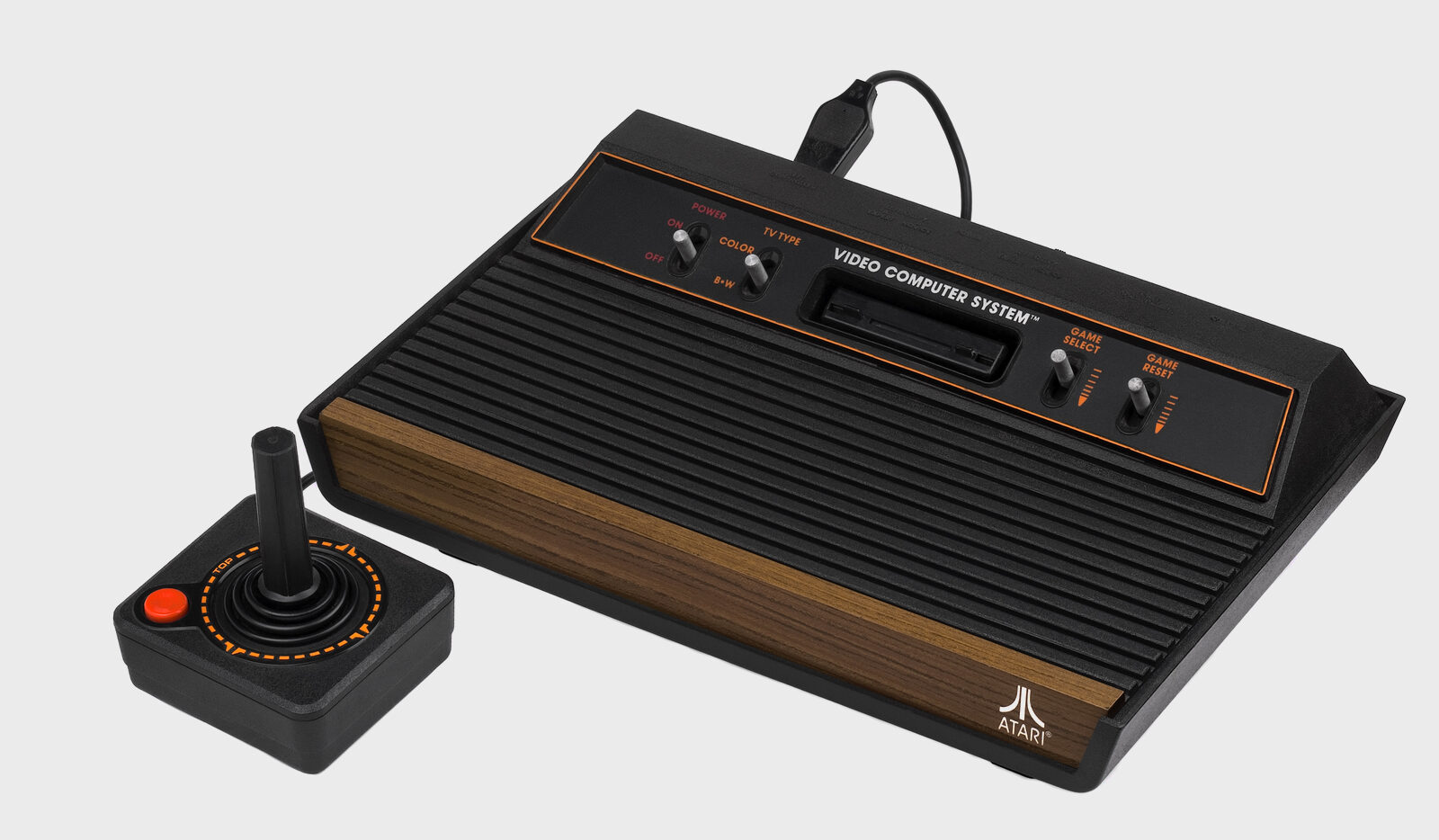
Gene Landrum, a consultant Atari brought in after he had already worked on the Channel F, told them to make it look like furniture. Wood grain. Cartridges that a child could not wreck with static. He also suggested four or five built-in games plus the carts; that part did not survive. What survived is the veneer. The first production run, 1977, was made in Sunnyvale from thick polystyrene so an almost empty shell would still feel heavy in a shopper's hands. Collectors call those Heavy Sixers: six switches on the front, thick shielding, weight. Power, TV type (colour or black-and-white), game select, left difficulty, right difficulty, game reset. Production moved to Taiwan in 1978. Thinner plastic, lighter shield, Light Sixer. In 1980 the two difficulty switches migrated to the back and the front labels went to capital letters. That is the four-switch wood-grain deck in the photograph at the top of this page. In November 1982, beside the new Atari 5200, the VCS was renamed the Atari 2600 after the CX2600 part number, and the wood came off. All black. People call that one the Vader. I am reviewing the wood-grain machine. The Vader is the same computer in a different jacket.
Launch price, in the prose from the period, is US$199 with two joysticks and Combat. Other listings from the same year put it at US$189.95. Those are not the same number, and I am not going to flatten them. Combat is the pack-in. It is Kee Games' Tank (1974) and Atari's Jet Fighter (1975) living on one 2 KB cartridge. The other eight launch titles: Air-Sea Battle, Basic Math, Blackjack, Indy 500, Star Ship, Street Racer, Surround, Video Olympics. Indy 500 shipped with driving controllers that spin freely. Street Racer and Video Olympics want the paddles. Atari expected to sell three or four cartridges per console. Joe Decuir later estimated six to eight.
What is actually in the case? A MOS Technology 6507 at 1.19 MHz. Thirteen address pins, and then the cartridge connector uses one of those as chip-select, which leaves a 4 KB program window unless a later cart does bank switching. Combat is 2 KB, so the original team thought 4 KB was plenty. The console has 128 bytes of RAM. That is not a typo. One hundred and twenty-eight bytes for scratch space, the call stack, and game state. There is no frame buffer. The TIA holds a one-colour 20-bit background register for the left half of a scan line — each bit is four pixels — and mirrors or repeats it on the right. Five sprites: two 8-pixel players, two missiles, one ball. NTSC output is 160 pixels across, 192 visible lines, 60 Hz, 16 colours at 8 brightness levels. PAL is 228 visible lines at 50 Hz and 13 colours. The program has to feed that chip in time with the electron gun. Programmers called it racing the beam. Game logic runs in the margins, when the beam is off the visible picture. I am not calling 128 bytes a joke. I am telling you the budget the TIA was designed around.
You might have missed this part about Christmas 1977. Atari sold between 350,000 and 400,000 VCS units that year. The first production batch had problems. Shoppers in 1977 still expected a home game to be Pong, one title soldered to a board. A wood-grain box that wanted you to buy Combat and then maybe Indy 500 was a new sentence. 1978: 550,000 sold of 800,000 made, Warner covering the rest. 1979: about 600,000, installed base a little over 1.3 million. Then Taito's Space Invaders, licensed, 1980. Atari sold 1.25 million of those cartridges and more than a million consoles that year. That is the hit that doubled the machine. Adventure, also 1980, hid an Easter egg. Asteroids in 1981 was the first 8 KB game, bank-switched. By 1982 the American installed base was being counted in the tens of millions, and Atari had become a synonym for the category.
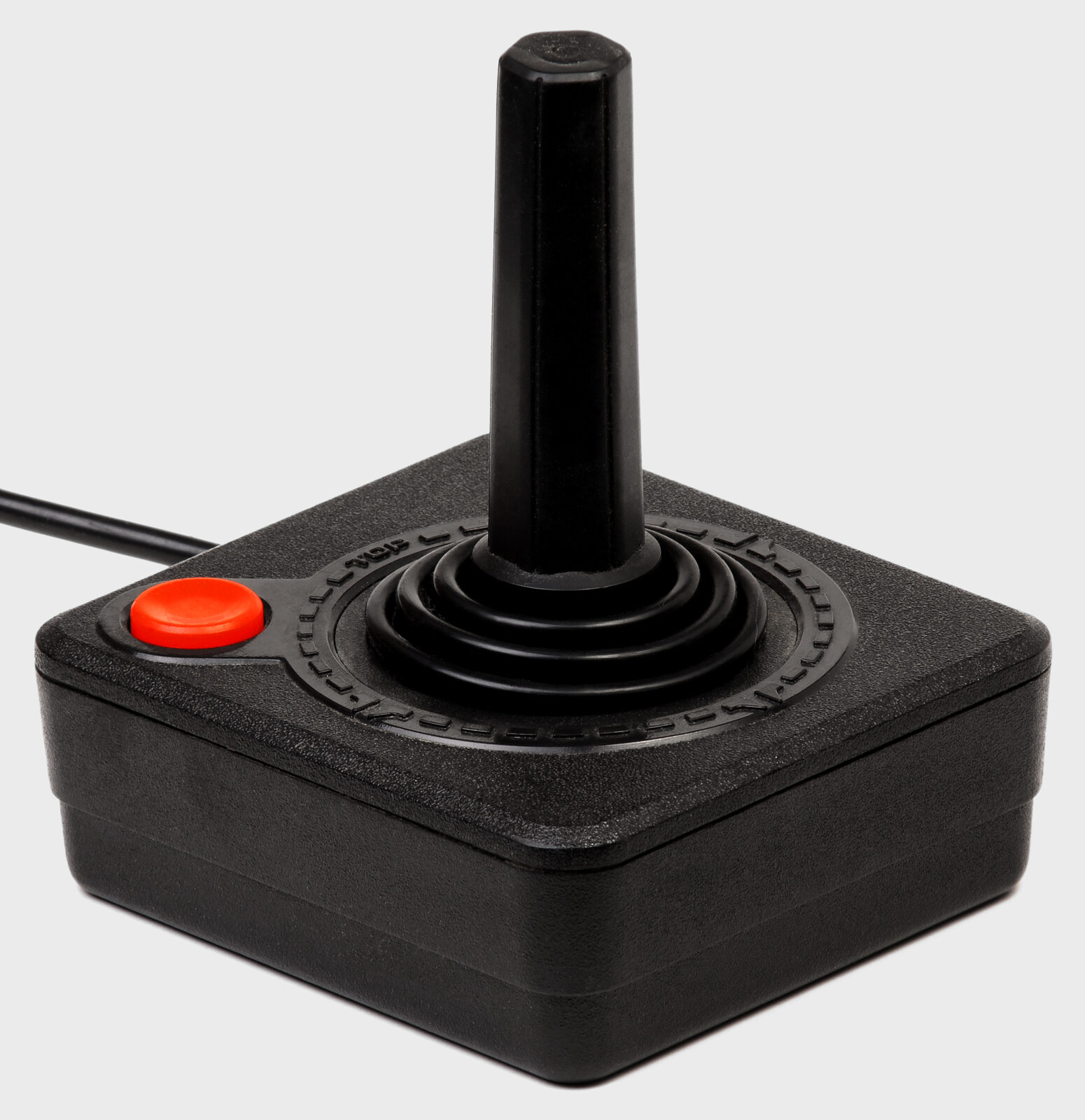
The CX40 joystick in the still is James C. Asher's, replacing the CX10 in less than a year. Square base, one red button, four directions, a cable into a DE-9 port that later showed up on the Commodore 64, the Atari 8-bit computers, the Amiga, the Atari ST, and a lot of other people's desks. The original bundle also had CX30 paddles. A CX50 Keyboard Controller arrived in June 1978 with Codebreaker and Hunt & Score. None of that makes the stick less of the object. If you learned video games in an English-speaking living room between 1977 and 1983, this is probably the grip you learned on.
Sears sold the same computer as the Tele-Games Video Arcade, continuing an OEM line that had started with Home Pong. Three Sears-exclusive games — Steeplechase, Stellar Track, Submarine Commander — were Atari-built. In Japan, Epoch had already been distributing the 2600; Atari's own Atari 2800 arrived in October 1983, a wedge with four controller ports, after Nintendo's Famicom had already taken that market. Europe got the VCS from 1978. Futuretronics distributed it in Australia. I do not have a sourced Australian dollar launch price, so I am leaving the tag off.
Four programmers left Atari, formed Activision in 1979, and started selling VCS cartridges in 1980. Atari sued. They settled. Activision paid a licensing fee. That settlement is the template the rest of the industry still uses: a console maker licenses third parties instead of trying to write every title in-house. Kaboom! and Pitfall! are the Activision numbers people still cite. By 1982, sixteen companies were making or announcing 2600 software. That is the open part of the story. The other part is 1983. Pac-Man on the 2600 became the system's best seller, more than 8 million copies, and was widely described as a poor likeness of the arcade. E.T. the Extra-Terrestrial was programmed in about six weeks for that Christmas. Atari produced on the order of four million E.T. cartridges and sold about 1.5 million. In September 1983 the company sent 14 truckloads of unsold cartridges and equipment to a landfill in New Mexico. When the site was dug in 2014, the haul was about 700,000 cartridges, not the urban-legend millions. Atari posted a US$536 million loss for 1983. Warner sold the consumer division to Jack Tramiel in July 1984.
Tramiel's Atari Corporation put the cost-reduced 2600 Jr. on sale in 1986, advertised under US$50, after Nintendo had already test-launched the NES in New York. The Jr. is a smaller case with a 7800-ish silhouette. The 6507 is still in there. The 128 bytes are still in there. The last Atari-licensed 2600 game in PAL territories is Klax, 1990. Production of the 2600 ended in 1992, after more than fourteen years. Estimated lifetime sales are 30 million. IGN in 2009 called it the number two console of all time and "the console that our entire industry is built upon." The National Toy Hall of Fame inducted it in 2007.
So the review, if you want it on one stick: a MOS 6507, 128 bytes, a TIA, wood grain because a consultant said the living room would accept furniture, Combat in the carton, Christmas 1977 as a messy first season, Space Invaders as the reason the messy first season got a second life. The four-switch wood-grain deck is the one most North American hands actually met. The six-switch Sunnyvale Heavy Sixer is the first one. The Jr. is the last one. Same switches in spirit. Game select. Game reset. A cartridge standing up out of the slot like a paperback. You still race the beam. That was never a metaphor. That was the scan line.
The paper
Comments
No notes on this story yet.
Sign in to comment