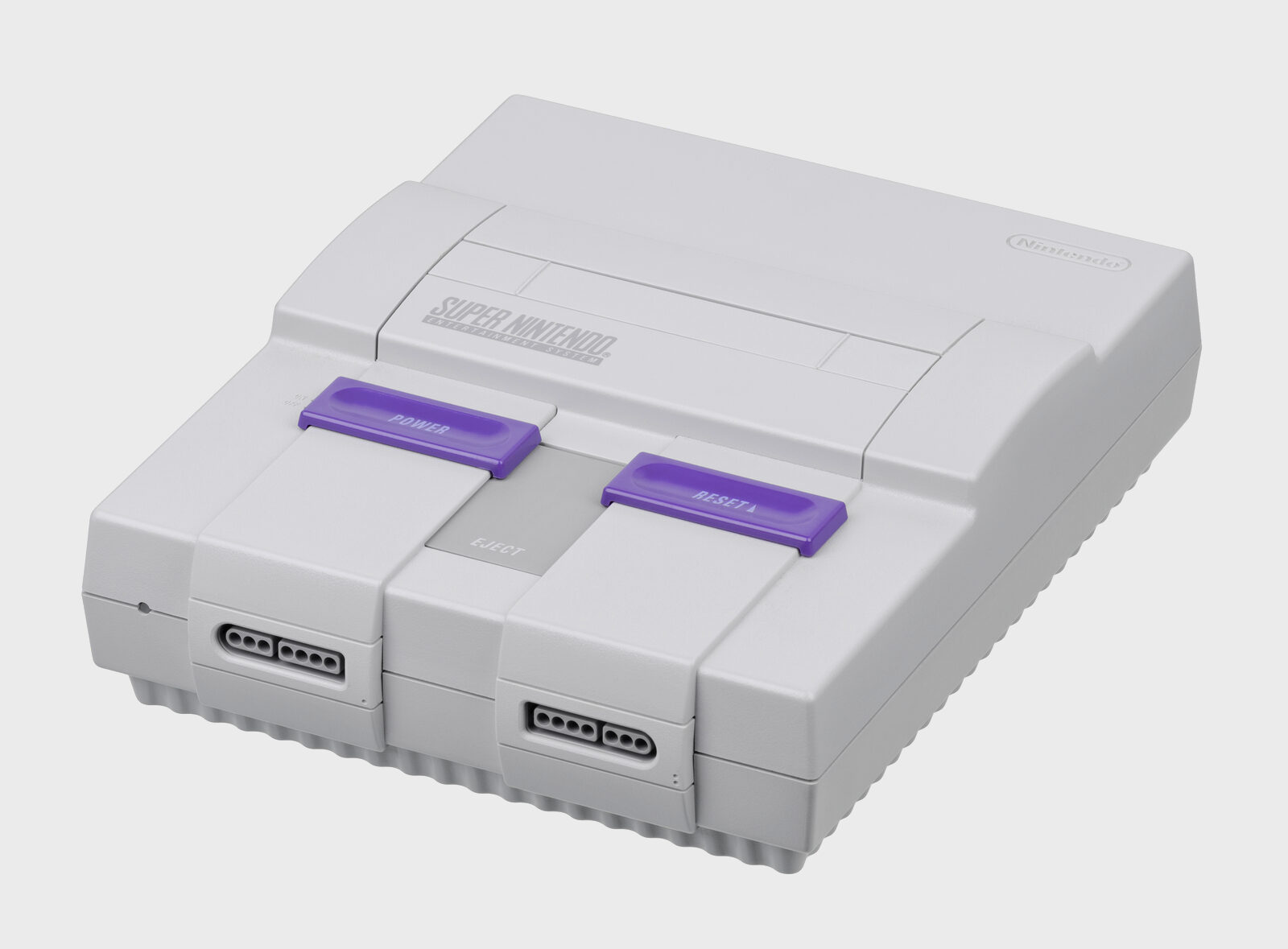
Here's what happened. Nintendo put the Super Famicom on Japanese shelves on 21 November 1990 for ¥25,000. The first shipment was 300,000 units and it sold out in hours. The North American Super Nintendo Entertainment System, a different shell around the same 16-bit chipset, began reaching stores on 23 August 1991 at US$199, with an official nationwide date of 9 September. Australia's date is 3 July 1992. The United Kingdom and Ireland got it on 11 April 1992 for £150. You are not reading a review of Super Mario World, though that cartridge is the pack-in. You are reading a review of the deck, the pad, and two purple buttons.
The short version is the controller. Lance Barr, who had already turned the Famicom into the NES Control Deck, laid out four face buttons in a diamond and added two shoulders. On the North American pad, X and Y are lavender and concave. A and B are purple and convex. That's the pair. The Japanese and PAL pads use four colours — green, blue, yellow, red — and those four colours sit in the Super Famicom logo. Same diamond. Same L and R. The North American Control Deck matches the pad: purple sliding switches, dark grey eject, a curved top so you would not rest a drink on it the way people had rested drinks on the flat NES. Boxy in America. Rounded in Japan and in the PAL territories, which inherited the Super Famicom silhouette and the Super NES name.
Masayuki Uemura designed this one too. Nintendo R&D2. The brief was a 16-bit follow-up after NEC's PC Engine (30 October 1987) and Sega's Mega Drive (29 October 1988) had already shown Japan what the next step looked like. Hiroshi Yamauchi had talked about the Super Famicom in the Kyoto Shimbun on 9 September 1987. A prototype shown to the Japanese press on 28 July 1989 still had only 32 KB of work RAM. Chip shortages pushed the launch into autumn 1990. The final case appeared at Shoshinkai on 28–29 August 1990, with late Super Mario World and F-Zero builds. Nintendo took 1.5 million pre-orders and ran what it called Operation Midnight Shipping on 20 November: 100 trucks, late at night, to keep the first cartons off the ordinary roads. I am reporting the logistics. I am not decorating them.
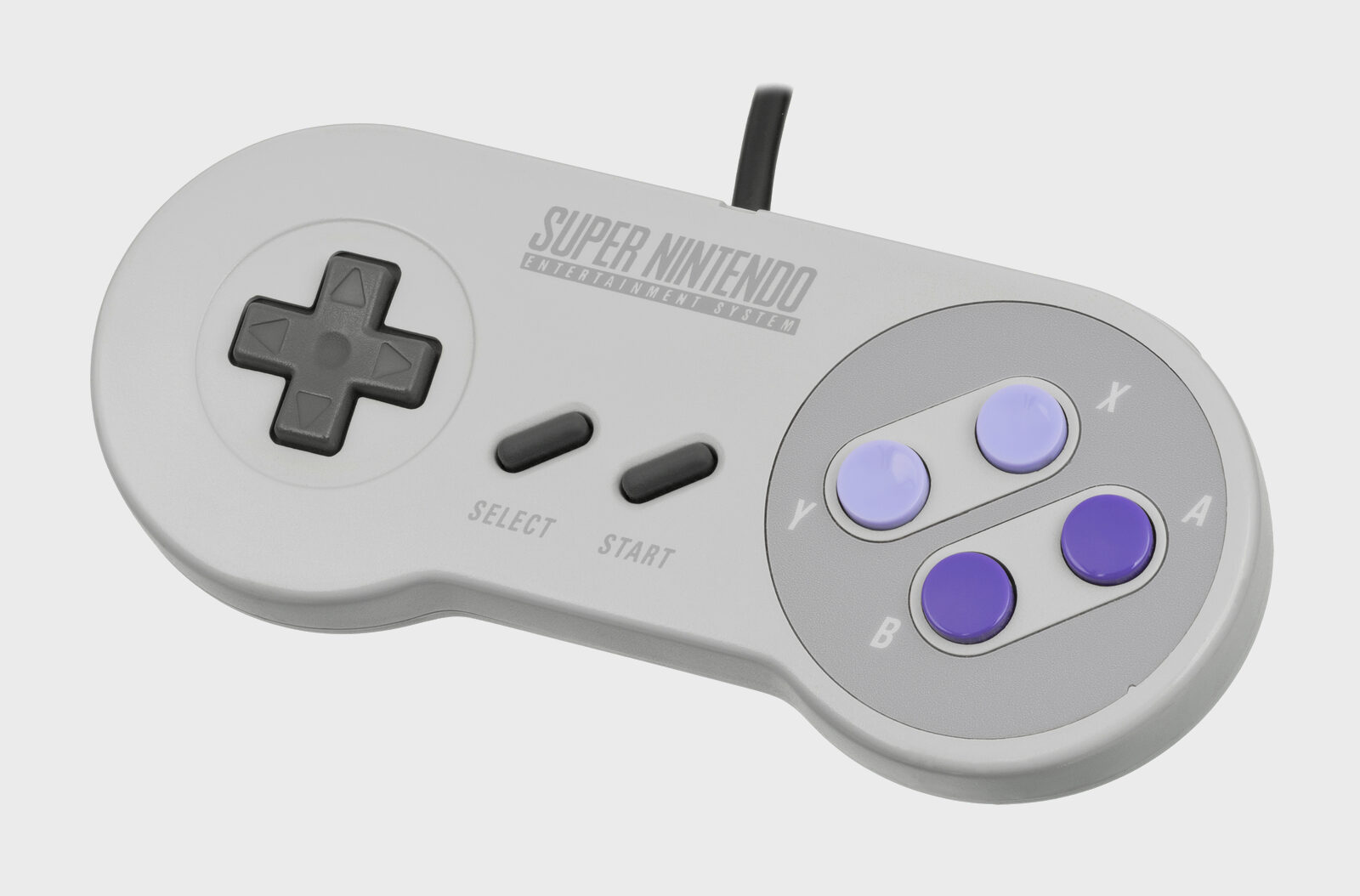
Pick the pad up. The NES brick was a rectangle with a D-pad, A, B, Start, Select. This one adds X and Y and the two shoulders, and it curves into the palms. Later pads — PlayStation, Dreamcast, Xbox, the Wii Classic Controller, the Nintendo DS face layout — keep that diamond. That is not a vibe. That is a lineage you can count with a finger. The Super NES Mouse and the Super Scope are the other official verbs; Super Game Boy puts a Game Boy cartridge in the Super NES slot and lets the 16-bit deck supply palettes and a border. Hudson's Super Multitap hangs off controller port 2 and takes the player count to five in the games that advertise it. None of those extras replace the two purple buttons. They sit on top of them.
Inside the deck: a Ricoh 5A22, a 16-bit derivative of the Western Design Center 65C816. Bill Mensch, who had co-created the 8-bit 6502, licensed Ricoh to supply 8-bit and 16-bit WDC parts to Nintendo. In NTSC regions the 5A22's nominal clock is 3.58 MHz, and it slows to 2.68 MHz or 1.79 MHz when it talks to slower peripherals. Work RAM is 128 KB. Separate from that: 64 KB of SRAM for the picture processing units, and 64 KB of PSRAM for the audio subsystem. Display modes include 256 × 224, 512 × 224, and 512 × 448. The colour generator can choose from 32,768 colours. The audio is a Sony-designed S-SMP: an SPC700 driving a DSP, eight BRR-compressed voices, stereo, echo if you ask for it. Ken Kutaragi designed that sound chip at Sony without, at first, telling his own management; Norio Ohga let him finish. Eight-channel ADPCM on a cartridge console in 1990 is the sentence. The 5A22 is the other one.
Mode 7 is a background mode, not a game. The PPUs can rotate and scale a background to fake a floor receding toward a horizon. F-Zero and Pilotwings, both in the North American launch group, are the demonstrations Nintendo put on the shelf so you would see it. Super Mario World uses it more quietly. The other expansion path is a chip in the cartridge. Super FX is a RISC coprocessor for work the 5A22 cannot do cheaply, including 3D polygons; Star Fox is the title people point at. DSP-1 and its siblings do fixed-point vector maths. SA-1 is another 65C816, clocked at 10.7 MHz, with its own extras. Nintendo's bet was not to put a more expensive CPU in every deck in 1990. It was to leave the cartridge edge open so a game could bring a specialist. That is an engineering fact, not a slogan.
Japanese launch games were Super Mario World and F-Zero, with Bombuzal in the launch week. North America bundled Super Mario World with the Control Deck; the other early titles include F-Zero, Pilotwings, SimCity, and Gradius III. Super Mario World is the pack-in that moved 20.6 million copies with the hardware. Street Fighter II: The World Warrior is the stand-alone best seller at 6.3 million. I am not reviewing those games here. I am telling you what the deck was sold next to.
You might have missed the Australian date if you only memorised August 1991. PAL Super NES hardware, Super Famicom shape, Super NES name, 3 July 1992. I do not have a sourced Australian dollar launch price, so I am not printing one. Germany's date is 15 August 1992. Chile, 8 June 1992. Brazil, through Playtronic, 30 August 1993, in the North American shell. South Korea got a Super Comboy from Hyundai, because Japanese cultural imports were restricted. Regional lockout on this generation is both physical — North American carts are a grooved rectangle; Japanese and PAL carts are narrower with a curved front — and electronic, another CIC pair, D411 in the cartridge, F411 in the console on many boards. Japanese and North American consoles share a region chip. PAL is the other conversation, and PAL is 50 Hz unless a later owner adds a switch. A PAL Super Mario World on an NTSC deck is a different speed. That is the television standard doing maths, not a pal complaining.
Dimensions, from the Japanese Super Famicom instruction manual as quoted in the SHVC hardware listings: 200 mm wide, 242 mm deep, 74 mm high, about 1,350 g with both controllers. Another listing puts the deck alone at 72 mm and about 600 g; I am giving you both, and I am putting the manual's 74 mm / 1,350 g with pads in the lead because it is the figure printed for owners. The North American SNS-001 is a different case. I do not have a millimetre figure for Barr's American shell that I trust enough to print, so I am not converting a guess. Power on the Super Famicom is the same family of adapter the Famicom used, DC 10 V, about 8 W. The Famicom spec sheets also give a working temperature of 5 to 40 °C; treat that as the family range, not a lab certificate for every SNS board.
Nintendo sold 49.10 million Super NES and Super Famicom units: 23.35 million in North America, 17.17 million in Japan, 8.58 million elsewhere. It is the best-selling fourth-generation home console. The NES family had done 61.91 million; this one did not repeat that number and did not need to. Production in North America ended in 1999. Japan continued the Super Famicom until 25 September 2003. A slimmer New-Style Super NES, SNS-101, arrived in North America in October 1997 at US$99.95, often with Super Mario World 2: Yoshi's Island, no expansion port, composite only unless you restore the other pins. Super Famicom Jr., 27 March 1998, ¥7,800. Europe did not get that shrink. The original pale ABS can yellow in air; that is the plastic, not a stain you left. Retrobrighting is a later hobbyist answer. I am noting the chemistry. I am not writing you a repair manual.
One more date, because the 16-bit deck did not leave the room when 32-bit disks arrived. Rare's Donkey Kong Country, November 1994, used pre-rendered models on Silicon Graphics workstations and still ran on this cartridge slot. 6.1 million copies in the last 45 days of 1994, which is a hardware review's way of saying the 5A22 was not finished just because a PlayStation had been announced. Super Game Boy kept Game Boy software on the same television. Satellaview, Japan only, from 23 April 1995, hung a satellite modem off the bottom expansion port. The CD add-on Nintendo started with Sony did not ship; Sony's later PlayStation is the machine that project turned into. Philips kept some Mario and Zelda licences for CD-i. Those are neighbouring objects. The object in front of you is still a grey (or purple-switch) cartridge deck with 128 KB of work RAM and a pad whose two convex buttons are purple in North America.
So. 21 November 1990, ¥25,000, Kyoto's second programmable home computer from the same engineer who had done the first. 23 August 1991, US$199, a boxier shell, Super Mario World in the carton. 3 July 1992, Australia, PAL. Ricoh 5A22, 128 KB, Mode 7 on the background, Super FX when a cart pays for it, eight voices from Sony's little coprocessor. Two purple buttons, if you bought the American pad. Four colours, if you bought the other one. The short version is that Nintendo did not put a more expensive CPU in every living room. It put a 16-bit one in the deck, left the cartridge edge open, and let A and B sit where a thumb already knew how to find them.
The paper
Comments
No notes on this story yet.
Sign in to comment