Here's what happened. Nintendo put a grey plastic box in New York toy stores on 18 October 1985 and asked Americans to call it a Control Deck. The machine inside that box had already been on sale in Japan for two years and two months, as the Family Computer, from 15 July 1983. Same Ricoh chipset. Same 2 KB of work RAM. A different shell, a different name, and a front door that pretended to be a videocassette recorder.
The short version is this. The object under review is the console. Not Super Mario Bros, though that cartridge later rode in the cheaper American bundle. Not a single evening on a sofa. The grey NES Control Deck, and the red-and-white Famicom it was redesigned from. You might have missed this part if you only remember the 1985 date: Japan got there first, at ¥14,800, with Donkey Kong, Donkey Kong Jr., and Popeye in the launch pile.
Masayuki Uemura's Nintendo R&D2 built it after president Hiroshi Yamauchi asked for a cheap home machine that could run arcade games from cartridges. The hardware leans on Nintendo's own Donkey Kong arcade board and on Namco's Galaxian. The D-pad on the controller is the one Gunpei Yokoi's R&D1 had already put on Game & Watch. Yamauchi had talked about a target near ¥9,800. Street price on 15 July 1983 was ¥14,800, still less than half what rival Japanese consoles were asking. The team called the project GameCom until Uemura's wife suggested Famicom, on the logic that it was not quite a pasokon.
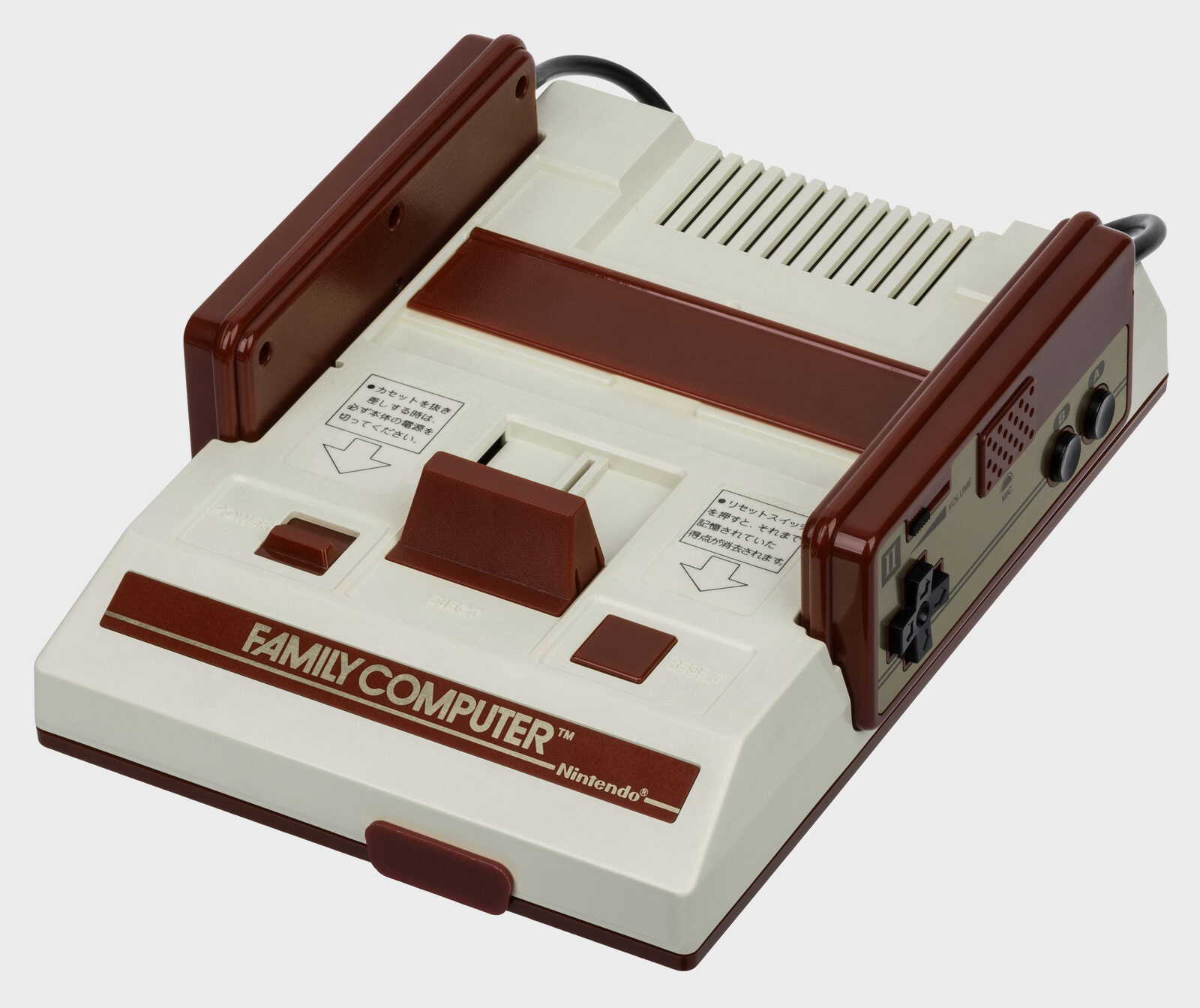
Look at that Japanese case before you go back to the grey one. The HVC specification sheets put the Family Computer at 150 mm wide, 220 mm deep, and 60 mm high, about 620 g with both controllers. Two hardwired pads sit in moulded holsters on the sides. Controller I has Start and Select. Controller II has a microphone and a volume slider instead. Early units shipped with square A and B buttons; after they stuck, later runs went round. A 15-pin expansion port on the front is there for extras. RF only, on the original. No lockout chip. That last fact matters later.
The CPU is a Ricoh 2A03 in NTSC machines, clocked at 1.79 MHz, and a Ricoh 2A07 in PAL machines at 1.66 MHz. Both are 8-bit MOS 6502 variants. Nintendo disabled the 6502's binary-coded decimal mode on these parts. The CPU sees 2 KB of onboard work RAM. Graphics are a Ricoh 2C02 Picture Processing Unit at 5.37 MHz, with 2 KB of video RAM, 256 bytes of object attribute memory for up to 64 sprites, and 28 bytes of palette RAM. Standard display is 256 × 240. Up to 25 colours on screen from 54 usable colours in the palette. Sound is five channels on an audio processing unit integrated with the CPU: two pulse, one triangle, one noise, one DPCM sample channel. That is the computer. The grey box is a costume for it.
Can a toy company walk into the United States in 1985, two years after the North American video game crash, and sell another programmable console? Nintendo tried the door that was already open. An Atari distribution deal for the Famicom was supposed to close at the June 1983 Summer CES. During that show Atari found Coleco demoing an unlicensed Donkey Kong on the Adam computer. The deal slipped, Atari CEO Ray Kassar was fired, and Nintendo decided to sell the machine itself. The first American prototype, the Advanced Video System, showed at Winter CES in January 1985 with a keyboard, a cassette drive, and infrared pads. Electronic Games wrote that March that the American video game market had virtually disappeared. The AVS did not ship.
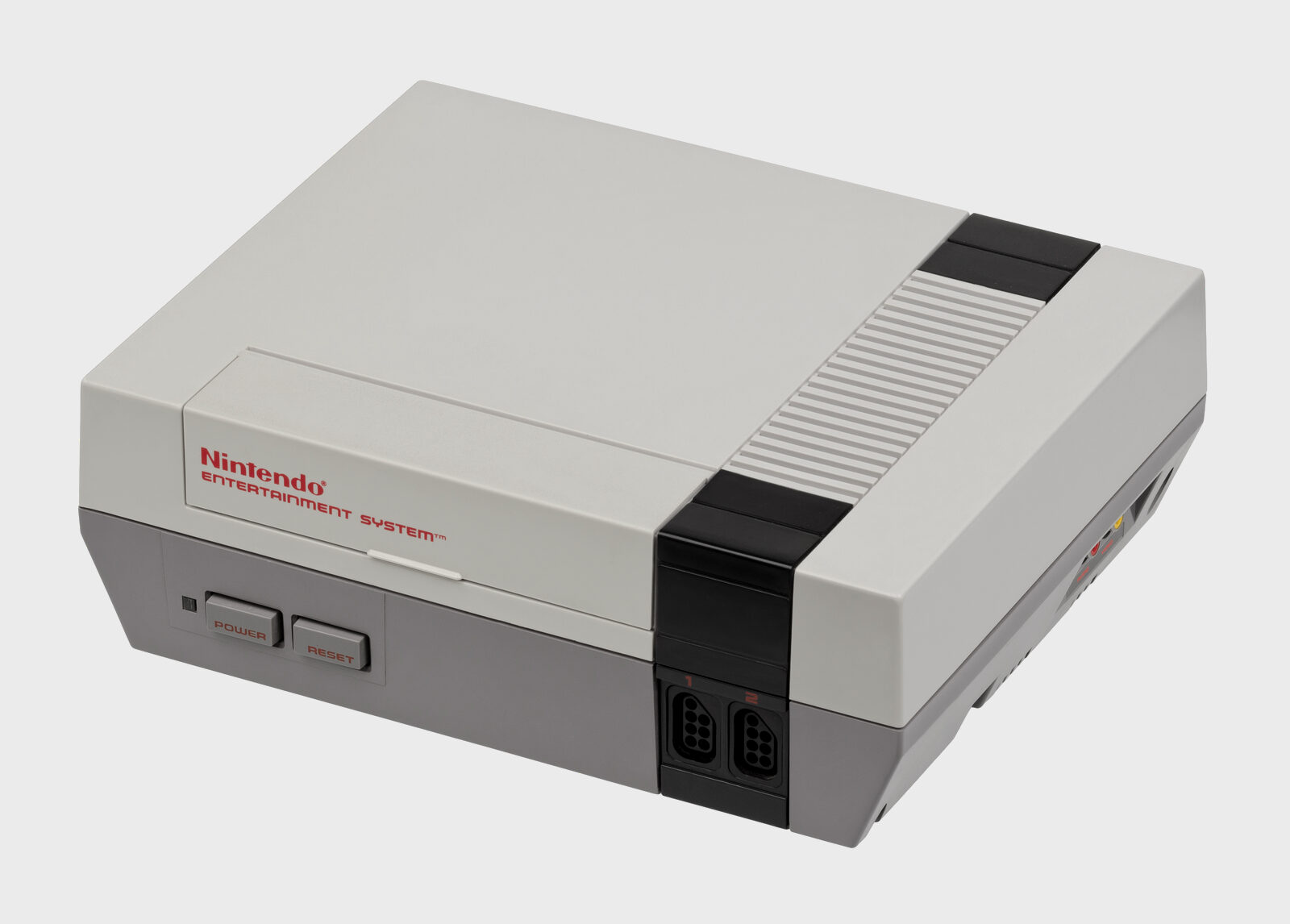
What shipped was a redesign. Nintendo of America designers Lance Barr and Don James took a Japanese prototype they nicknamed the lunchbox and turned it into a two-tone grey deck with a black stripe and red lettering. Front-loading, zero-insertion-force slot, hinged door, cartridge hidden once it was in, modelled on a VCR so a toy aisle would not have to say "video game." Marketing manager Gail Tilden coined Control Deck and Game Pak. Detachable wired pads on proprietary 7-pin ports replaced the Famicom's hardwired pair. The NES cartridge edge is 72 pins against the Famicom's 60. Some early American games are Japanese carts on an adapter inside the larger grey shell. That is not folklore. That is how Nintendo reused inventory.
New York City, 18 October 1985, was a test. About 100,000 Deluxe Set systems went to selected retailers, with a buyback if they did not move. The Deluxe Set retailed at US$179.99. In the box: Control Deck, two controllers, the NES Zapper light gun, R.O.B. the Robotic Operating Buddy, Gyromite, and Duck Hunt. Seventeen games were in the launch line, among them Excitebike, Hogan's Alley, Ice Climber, Kung Fu, and Super Mario Bros., with a modern asterisk that some later writers have questioned whether Super Mario Bros. was on the shelf that first weekend. Contemporaneous lists in Computer Entertainer and The Milwaukee Journal name it among the seventeen. Los Angeles followed in February 1986. The rest of North America, 27 September 1986.
You might have missed this part about the pack-in. The 1985 Deluxe Set does not put Super Mario Bros. in the box. Gyromite and Duck Hunt are the two Game Paks that arrive with R.O.B. and the Zapper. Ahead of the nationwide 1986 launch, Nintendo added a basic Control Deck set: two controllers, Super Mario Bros., US$99.99. That is the Super Mario pack-in. In 1988 the Deluxe Set gave way to the Action Set, also US$99.99, with the Zapper and a dual Game Pak of Super Mario Bros. and Duck Hunt. The Power Set that same year added the Power Pad and a triple pak. The object changed price. The grey box stayed.
Australia is 1987. Nintendo split Europe and Australasia into two marketing regions. Mainland Europe, excluding Italy, went through local distributors from 1986 into 1988; Scandinavia's date is 1 September 1986, through Bergsala. The second region — United Kingdom, Ireland, Italy, Australia, New Zealand — was Mattel's in 1987. I do not have a sourced Australian dollar launch price for that Mattel NES, so I am not going to invent one. What I do have, later: the New-Style NES, the top-loader, reached Australia with a triple Game Pak of Super Mario Bros., Tetris, and Nintendo World Cup at A$79.99, or A$69.99 without the pak. That is 1993, not 1987. PAL NES CPUs are the 2A07 at 1.66 MHz. Same 256 × 240 idea, different television standard, different lockout region.
The lockout is a chip. Nintendo calls the system 10NES. The patents call the part a Checking Integrated Circuit, CIC. A Sharp 4-bit SM590 microcontroller lives in the Control Deck as the lock. A matching chip lives in each licensed cartridge as the key. They share a clock and swap a bitstream. If the handshake fails, the console-side CIC pulses reset at 1 Hz. The red power light blinks. The game does not run. U.S. patent 4,799,635 covers the program. The Famicom, as sold in Japan, has no such chip, which is why unlicensed cartridges were ordinary there. The New-Style NES of October 1993, model NES-101, omits the 10NES. Nintendo put the chip in the front-loader to keep the American library inside a licensed fence after the 1983 crash. The same chip is also why a dirty connector can look like a dead console: the lock needs a constant conversation with the key, and a worn nickel spring in that ZIF slot will interrupt it.
That slot is the other engineering fact. Barr and James wanted a VCR door. What they got, over years of insertions, is a contact that bends, tarnishes, and collects dust faster than a standard card-edge. Nintendo's next home machine, the Super NES, went back to a top loader. Blowing into a Game Pak, which a generation treated as maintenance, adds moisture and speeds the tarnish. I am not scolding you. I am telling you what the metal does. The grey box still plays if the pins still meet. A lot of them still do.
Worlds of Wonder got the NES onto American shelves by tying it to Teddy Ruxpin and Lazer Tag. Nintendo of America later hired that sales team and took distribution in-house. By the end of 1986, more than a million NES units had sold in the United States. Nintendo's later consolidated figure for the whole family — Famicom and NES together — is 61.91 million: 19.35 million in Japan, 34 million in the Americas, 8.56 million elsewhere. North America and Europe discontinued the NES on 14 August 1995. Japan kept making Famicoms until 25 September 2003, the same day the Super Famicom line ended. The last Famicom, serial HN11033309, was kept by Nintendo and loaned to the Level X exhibition in Tokyo that winter.
Accessories are part of the object, because Nintendo sold the American deck as a system of toys. The Zapper is a light gun for Duck Hunt, Hogan's Alley, Wild Gunman. R.O.B. is a battery robot that reads on-screen flashes and knocks gyro stacks around in Gyromite and Stack-Up. Few households kept using R.O.B. after the unboxing. He did the job he was hired for in 1985: he made the Control Deck look like something a toy store could stand next to a talking bear. The Famicom Disk System, Japan only, 21 February 1986, ¥15,000, is the other fork: a 76 mm Quick Disk add-on with extra sound and cheaper rewrites at retail kiosks. It sold about 4.4 million by 1990 and then lost the argument to cheaper, larger ROM cartridges. Australia never got that disk. Australia got the grey box, through Mattel, in 1987.
So what are you looking at, on a desk, in 2026? A two-tone grey rectangle with a red logo on a flap, two square buttons, a red LED, and numbered controller ports in a black stripe. Inside: 2 KB of work RAM, a Ricoh 6502 cousin, a PPU that thinks in 256 × 240, a CIC that will reset you once a second if the key is missing. The Japanese original is 150 mm by 220 mm by 60 mm of cream and dark red, controllers in the walls, microphone on pad II, no lockout. Nintendo sold both of them, under two names, into a market that had just learned to distrust this category of plastic. The grey box is the American answer to that distrust. It still looks like a VCR that never ate a tape.
The paper
Comments
No notes on this story yet.
Sign in to comment