
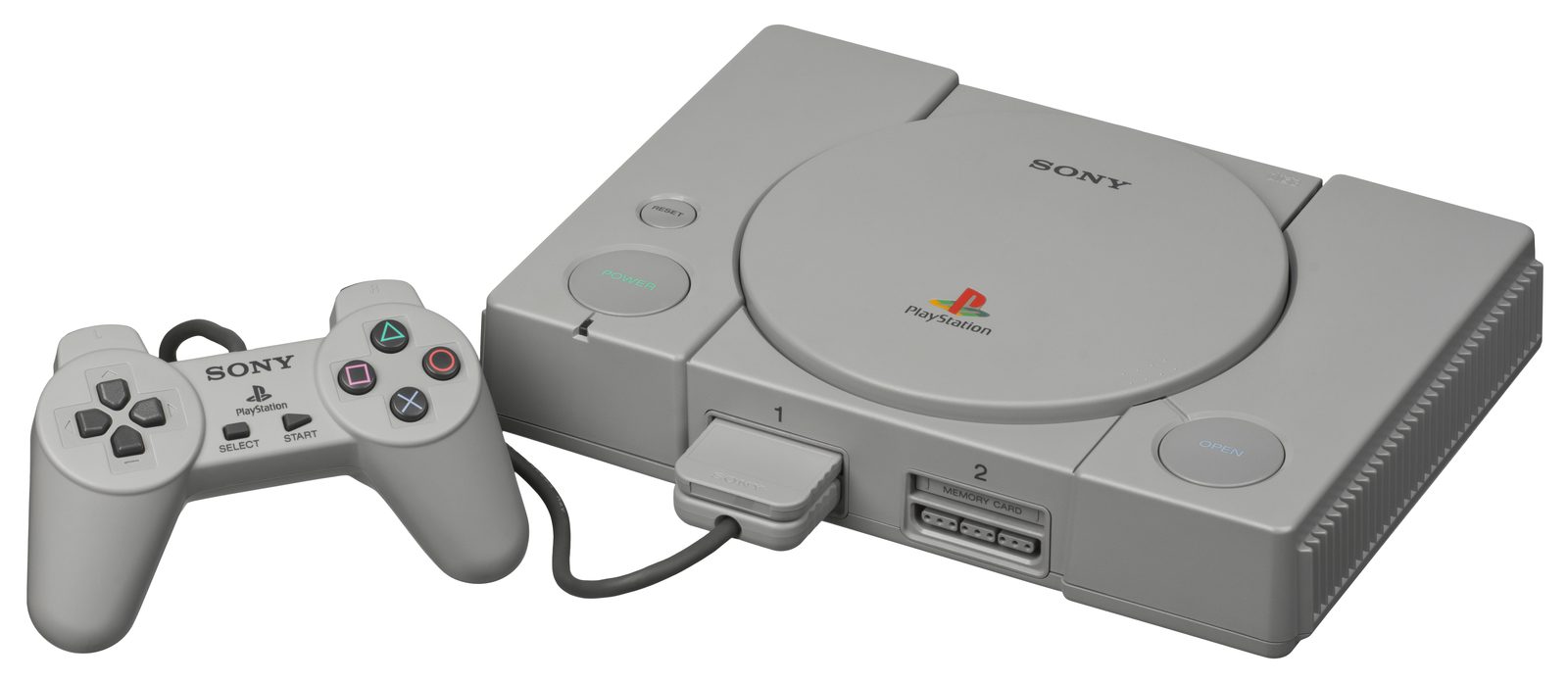
A grey brick. That’s the machine Sony Computer Entertainment put in Japanese shops on 3 December 1994. The manufacturer is Sony. The Japanese launch model is SCPH-1000. The original fat shell is 45 millimetres high, 260 millimetres wide and 185 millimetres deep. Inside: a MIPS R3000-class CPU, made by LSI Logic, clocked at 33.8688 MHz, with a geometry coprocessor on the same die. Main RAM is 2 MB. Video RAM on the launch boards is 1 MB. The medium is compact disc. The Japanese launch price was ¥39,800. The games are not cartridges. They are CDs that sit in a tray under a lid you lift with a button marked Open.
This is a review of that brick, not of a racing game that later sold 10.85 million copies on it. The short version is: Sony built a 32-bit home machine around a cheap optical disc, spent the first year teaching publishers that C was an acceptable way to talk to a console, and then spent eleven years not stopping production. The object on the table is still the same object. Warm grey plastic. A disc lid. Two controller ports and two memory-card slots in a row on the front. Power and Open on the right. Reset beside them, until the PS one folded Reset into a double-press of Power. Four shapes on the pad: triangle, circle, cross, square.
Here’s what happened. Ken Kutaragi’s group had already put the SPC-700 in Nintendo’s Super Famicom. A 1988 deal with Nintendo was supposed to yield a CD add-on and a Sony-branded Super Disc machine. At the June 1991 Consumer Electronics Show in Las Vegas, Nintendo announced it had gone to Philips instead. Sony kept the work. Norio Ohga backed Kutaragi. Sony Computer Entertainment was formed out of Sony and Sony Music Entertainment Japan, which already knew how to press compact discs. The public announcement that Sony was entering the console market came on 27 October 1993. The name and the final grey design were shown on 10 May 1994. Sega’s Virtua Fighter, in Japanese arcades in 1993, is the title Sony’s own people later named as the proof that 3D polygons were the point.
3 December 1994 in Japan, a week after Sega’s Saturn. Long queues. 100,000 units on the first day, two million inside six months. By the end of 1994 Japan had taken about 300,000 PlayStations against 500,000 Saturns. North America was 9 September 1995 at US$299, with no game in the box and about 17 titles on day one. Steve Race, running Sony’s American arm, at the first E3 in Los Angeles on 11 May 1995, answered Sega’s US$399 Saturn surprise by saying “two ninety-nine” and sitting down. Europe is 29 September 1995. PAL. £299. That date is not a rumour. Australia is not the same morning. Sony’s own business-development table, and the Australian press marking the thirtieth year, put the Australian street date on 15 November 1995.
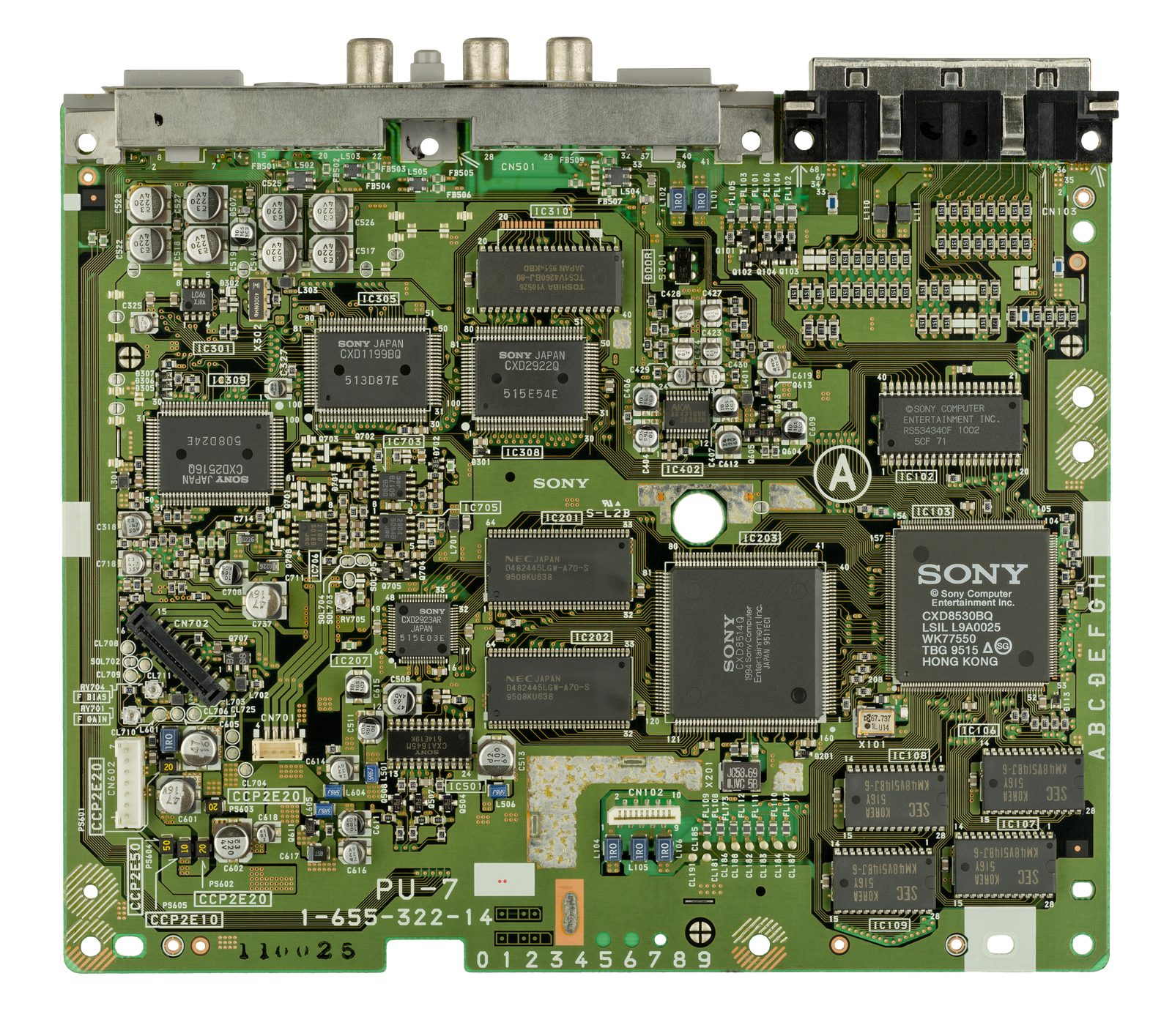
You might have missed this part. The letters SCPH-1000 and the letters SCPH-1001 are not the same silicon. The Japanese launch unit, SCPH-1000, is the only retail PlayStation with a native S-Video socket. Every later fat model dropped it. North American SCPH-1001 and European SCPH-1002 kept the 100x numbering and lost the S-Video port; internally they match Japan’s revised SCPH-3000 more than they match the 1000. Early 1000s sit on a PU-7 board, Rev. A or B GPU, dual-ported VRAM, and they are the ones collectors still talk about when full-motion video skips. The laser assembly is a KSM-440AAM with a plastic sled, parked close to the power supply. Heat plus plastic plus friction is an engineering limit. Later sleds went to die-cast metal. Later boards moved the pickup farther from the PSU. Sony did not change the grey brick’s outline to fix it. They changed the parts inside the same outline.
The CPU is the sentence. 33.8688 MHz. Thirty million instructions per second on paper. A coprocessor on the die, the Geometry Transfer Engine, does the matrix work so the GPU can rasterise. Sony quoted 180,000 polygons a second, 360,000 if they are flat-shaded, and 4,000 sprites. Colour depth is 16.7 million, with 32 levels of transparency. Output through the AV Multi port is composite, S-Video or RGB, from 256×224 up to 640×480 depending on the title. NTSC 240p and 480i; PAL 288p and 576i. There is no separate 2D chip. Two-dimensional things are polygons the GTE already knows how to move. Kutaragi later said doubling the RAM would have been easy and that the team refused, to keep the retail price down. 2 MB is the number they shipped. Later fat models from the SCPH-7501 onwards put 2 MB of video RAM in place of 1 MB. That change is a revision, not a new machine.
The disc is the other sentence. A pressed PlayStation CD carries a deliberate wobble in the pregap that a stock PC burner does not copy. The drive looks for that wobble before it will boot a game. Region is in the same scheme: Japanese, North American and PAL discs are locked to matching hardware. The last digit of the model number is the region. Zero is Japan. One is North America. Two is PAL, including Europe and Australia, with sub-variants for the mains plug. Two-A is Australia: Australian cord, composite cable. CD-ROM manufacturing, Sony already knew from the music division, is a week, not the two or three months a masked ROM cartridge took. Publishers could press more copies of a hit without waiting on a cartridge line Sega or Nintendo controlled. That is why Square put Final Fantasy VII here. That is why the brick outlived the argument about cartridges.
The pad that shipped in December 1994 has four separate direction buttons, four shoulder buttons, Start, Select, and those four shapes. Teiyu Goto designed it. European and North American pads are about 10 percent larger than the Japanese one. The PlayStation Analog Joystick arrived in Japan in April 1996. The Dual Analog Controller arrived in Japan in April 1997, two sticks, an Analog LED, rumble on the Japanese version, rumble omitted on the overseas Dual Analog. The DualShock — two vibration motors, rubbered sticks, longer handles — arrived in November 1997 and then became the default pad. DualShock is later. The brick launched with a digital pad. If your memory of this machine is analogue sticks, you are remembering 1997, not 1994.
The fat shell kept losing sockets as Sony cheapened the board. SCPH-550x, from April 1997, pulled the RCA jacks and the RFU power connector and moved the drive farther from the PSU. SCPH-700x, April 1998, bundled the DualShock and added Sound Scope visualisations in the CD player. SCPH-750x, from August 1998, cut chip count: system RAM from four packages to one, CD controller from three chips to one. SCPH-900x, May 1999, removed the parallel port. The serial port, used by the PlayStation Link Cable, lasted until the PS one deleted it. None of those revisions stopped being a grey brick. They are the same 260-millimetre outline with fewer holes in the back.
7 July 2000, Japan: the PS one. Same software. External 7.5-volt brick instead of an internal supply. Serial port gone. Reset folded into Power. The miniature is 38 millimetres by 193 millimetres by 144 millimetres, against the original 45 by 260 by 185. Sony said roughly one third the volume. 28.15 million PS one units by the time the line died. The original plus the miniature together are 102.49 million hardware units: 40.78 million North America, 40.12 million Europe, 21.59 million Asia. Production of the PlayStation stopped on 23 March 2006. Software shipments on the format reached 962 million. More than 4,000 games. The first computer-entertainment platform, Sony’s phrase, to pass 100 million hardware units.
Early 1000s skip FMV when the plastic sled wears. Sit the machine on a surface that dumps heat, or on its side, and some of those units behave. Sony also offered a service-centre modchip for older televisions that would not lock to the PlayStation’s signal. Those are maintenance notes. They are not a reason to pretend the brick was a different product from the one that sold a hundred million. The GPU still draws polygons. The drive still looks for a wobble. The pad still has a circle and a cross.
So. Japan 3 December 1994. United States 9 September 1995. Europe, PAL, 29 September 1995. Australia 15 November 1995. A MIPS R3000A at 33.8688 MHz, 2 MB of RAM, a CD-ROM in a 260-millimetre grey shell. SCPH-1000 if you want the Japanese S-Video socket. A later fat model if you want the quieter laser and the missing RCA jacks. DualShock if you are writing 1997. The object is a brick. You lift the lid. You put a disc in. You close it. The grey plastic does the rest.
The paper
Comments
No notes on this story yet.
Sign in to comment