
Thursday, 14:00 CEST. That’s 21:30 in Adelaide. After eight years as one stacked spacecraft, ESA’s Mercury Transfer Module lets go of the two science orbiters it has been carrying to Mercury.
The split is 3 September 2026, from the European Space Operations Centre in Darmstadt, Germany. ESA’s Mercury Planetary Orbiter and JAXA’s Mercury Magnetospheric Orbiter, Mio, stay stacked and fly free of the propulsion module. Instruments and cameras the transfer module blocked get a clear view.
ESA published the clock on 27 August: “Watch live: BepiColombo begins its arrival at Mercury.” Livestream from Darmstadt starts 13:45 CEST, 21:15 Adelaide. Separation is listed at 14:00 CEST. A one-hour break in the stream at 14:30. Resume 15:30. Earliest expected acquisition of signal after separation: 15:53 CEST, 23:23 Adelaide, then a spacecraft status check. The programme ends 16:15–16:45 CEST. Times, ESA wrote, are subject to change at short notice. YouTube and LinkedIn are the listed doors.
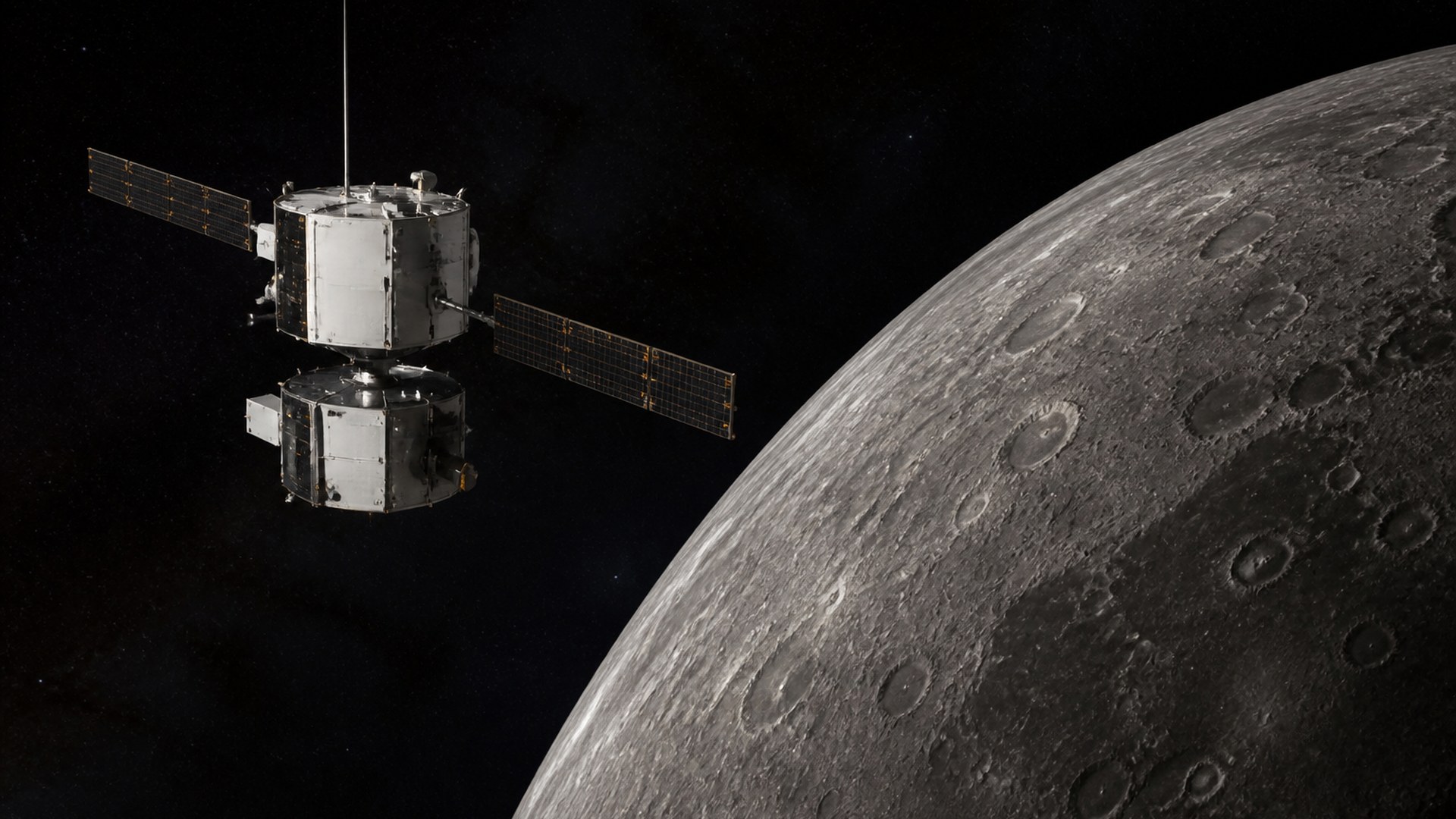
This is not orbit yet. It is the first named step of the Mercury Arrival Phase. ESA’s sentence is blunt. After eight years of travelling together as one stacked spacecraft, the Mercury Transfer Module, which has powered the interplanetary journey, separates from the two science orbiters. “Getting to Mercury is hard. Arriving there is even harder.” That pair of lines is ESA’s, on the same operations page. The transfer module has done the long work. Thursday it comes off.
What stays together is MPO and Mio, still locked, plus the Mio Sunshield and Interface Structure, MOSIF. ESA’s July operations note puts the first major milestone on 3 September: the MPO–Mio–MOSIF composite separates from the MTM. For weeks after that the two orbiters fly free of the propulsion module. European Pulse, filing from the 31 August media briefing, wrote that instruments and cameras previously blocked by the MTM finally get a clear view of space.
The next burns are chemical, and they are not Thursday. ESA’s simulations page dates Mercury orbit insertion to 21 November 2026, with a sequence of 16 burn manoeuvres that continue through to March 2027. European Pulse, covering the same briefing, put the next major milestone in late November and early December: controllers fire a critical sequence of chemical thruster burns to lower the orbit and bring the stack into Mercury’s gravitational grip. You can hold both clocks. 21 November is ESA’s insertion date. Late November and early December is the briefing’s chemical-burn window. Science operations, ESA and the briefing both say, begin in April 2027.
December has its own stamps. MPO and Mio separate on 9 December, ESA wrote, allowing Mio to enter its science orbit. The MOSIF sunshield, which stays on MPO after that, is released on 16 December. MPO then keeps adjusting, reaching its science orbit in March 2027. ESA’s Journey to Mercury page still carries the working polar orbits: Mio at 590 × 11,640 kilometres; MPO descending to 480 × 1,500 kilometres. Fine-tuning of those orbits is expected to take three months. That is the map Thursday opens, not the work Thursday finishes.
Launch was 20 October 2018 at 01:45 GMT, an Ariane 5 from Europe’s Spaceport in Kourou, French Guiana. Eight years. Nine planetary flybys: one Earth in April 2020, two Venus in October 2020 and August 2021, six Mercury between October 2021 and January 2025. ESA’s journey page is the list. “A big challenge for the mission is the Sun’s enormous gravity, which makes it difficult to place a spacecraft into a stable orbit around Mercury – even more energy is needed than sending a mission to Pluto.” After leaving Earth, BepiColombo had to brake against the Sun. Ion thrusters on the MTM supplied the low thrust. Without solar-electric propulsion, ESA wrote, it would not have been possible to bring two spacecraft of MPO and Mio’s mass to Mercury on a conventional launcher.
The Mercury Transfer Module page puts a number on that exhaust: xenon ions leave the thrusters at 50,000 metres per second, fifteen times a conventional chemical rocket. Three monitoring cameras on the MTM, M-CAMs, shoot black-and-white 1,024 × 1,024 frames of hardware — and, along the way, of Earth, Venus and Mercury. Thursday those cameras leave with the module.
The 31 August briefing named three ESA speakers: Prof. Geraint Jones, lead project scientist; Santa Martinez, mission manager; Ignacio Tanco, head of inner Solar System mission operations. European Pulse quoted them the next day. Martinez: “Mercury is a challenging destination. It’s very difficult to reach, it’s very difficult to operate there.” The two loads she named are temperature and light. “The main two aspects are really the extreme temperatures that go from −180 to 450°C, and also the solar radiation, which can be up to ten times what we have on Earth.” Tanco, at ESOC, called the operation “working on a knife edge,” and likened it to “operating with a very hot pizza oven running right on your back.” Solar panels have to sit at a precise angle: too far from the Sun and power drops; too close and they overheat. “There’s a lot of stuff that is going to be new on Thursday that the teams must prepare for,” he said. European Pulse recorded an 11-minute radio delay each way. Martinez again: “We know that it’s likely that not everything is going to go according to the nominal plan.” Then: “But we are ready, we are flexible, and we need to be prepared for the unexpected.”
Jones’s line is the reason for the eight-year detour. “To study the planet in any detail, we have to go there with a spacecraft.” ESA’s watch page: Europe’s and Japan’s first mission to Mercury, the first two-spacecraft mission to Mercury, and only the second mission ever to enter orbit about the rocky world. Operated under ESA leadership. JAXA supplies Mio.
The stack is four named pieces, not one. MTM. MPO. Mio. MOSIF. Nacho Clerigo, ESA BepiColombo operations manager, told the July simulations story: “The arrival phase is not a single event, but six months full of one-of-a-kind activities and critical operations.” Petr Shlyaev, ESA simulations officer: “Exactly eight years and two days ago we were in this room doing the same thing in preparation for Bepi’s launch. The fact that we are now here means that everything has worked out well.” December’s Mio release is a two-agency clock. “Mio is going to be released into space and MPO is the launcher. Many steps need to happen on both sides in a specific order and we need to be synchronised,” Clerigo said. That is 9 December, not Thursday.
After separation, ESA wrote, teams on Earth listen for post-separation acquisition of signal and run the first health checks. The 11-minute delay is the wait inside that wait. The earliest AOS stamp is 15:53 CEST — 23:23 in Adelaide, a Thursday night, not a morning launch. Then the stamps. 13:45 livestream. 14:00 split. 15:53 listen. 21 November insertion. 9 December Mio. 16 December sunshield. March 2027 MPO science orbit. April 2027 science.
The spent MTM, European Pulse wrote, becomes passive and uncontrollable, tumbles past Mercury, and stays in interplanetary space. Once captured, MPO manoeuvres to its dedicated polar orbit. Science operations for both begin in April 2027. Thursday is the hour the tug stops being in the way of the cameras. File the livestream. ESA on YouTube. ESOC, Darmstadt. 3 September 2026. 14:00 CEST, 12:00 UTC, 21:30 Adelaide. MTM off. MPO and Mio still stacked. Chemical burns later. Science in April. Not a launch. A separation.
The paper
Comments
No notes on this story yet.
Sign in to comment