
One Nation took Secret Harbour on Saturday. By Tuesday night, the national primary put Pauline Hanson’s party at twenty-three. Those two facts sat in the same week, and they don’t cancel each other out.
Here’s what the Guardian Essential poll filed for Tom McIlroy: Labor primary 26 percent, Coalition primary 26 percent, One Nation primary 23 percent. Albanese’s approval is 35 percent. Disapproval is 56 percent. That’s his lowest approval as prime minister. The margin of error is about three percent. More than a thousand Australians were polled. The short version is the national dial moved away from the government, and it also moved away from One Nation’s May peak, even after a by-election win on the Western Australian coast.
You might have missed how sharp the month-to-month Labor drop is. Essential had Labor on 31 percent a month ago. It’s 26 now. Five points in thirty days. The Coalition is up from 22 percent in July to 26 percent in this survey. One Nation is down from a May peak of 28 percent to 23 percent — also a five-point fall from that high, even though Luke Herdegen’s win on 29 August gave the party its first Western Australian lower-house seat. Local wins and national primaries are different instruments. This week both are on the table.
Peter Lewis, Essential Media’s executive director, didn’t dress it up. “This month’s poll shows some churn away from the government towards both One Nation and to the Coalition as a messy immigration debate swirls,” he said. He also put a number on the mood: 59 percent say the nation is on the wrong track — the lowest since Essential started tracking that question in 2022. The drivers he named were cost of living, global uncertainty, and “extremely high levels of concern about the impact of AI on work.”
What the primaries actually say
Start with the three-way split, because that’s the new shape of the national primary in this poll. Labor 26. Coalition 26. One Nation 23. In a two-party world those first two numbers would be the whole story. In this poll they aren’t. Nearly a quarter of the primary is sitting with a party that, a decade ago, was treated as a protest fringe. You don’t need a model run to see why every major party room is watching that third column.
Labor’s five-point month drop is the loudest single move. Going from 31 to 26 inside a month is the kind of slide that forces a government to ask which debate is bleeding it. Lewis’s answer is immigration — specifically the fight over net overseas migration, or NOM, and the broader argument about arrivals, housing, and who gets to set the number.
The Coalition’s climb from 22 in July to 26 now is quieter, but it’s real. Angus Taylor’s personal numbers in the same survey are split: 33 percent approve of his performance as opposition leader, 35 percent disapprove. That’s not a coronation. It’s also not a collapse. The party primary moved up while the leader’s net sits roughly flat and slightly underwater.
One Nation’s 23 percent is the number that will be argued over longest. The party just won a by-election. The national primary is down five points from May. Both can be true. By-elections are local, preferential, and shaped by the candidates on the ballot that day. A national Essential sample is a different ask. McIlroy’s piece makes the contrast explicit: despite Secret Harbour, the national One Nation primary slipped from the May peak. If you only read the WA result, you’d expect a national bounce. The poll didn’t deliver one.
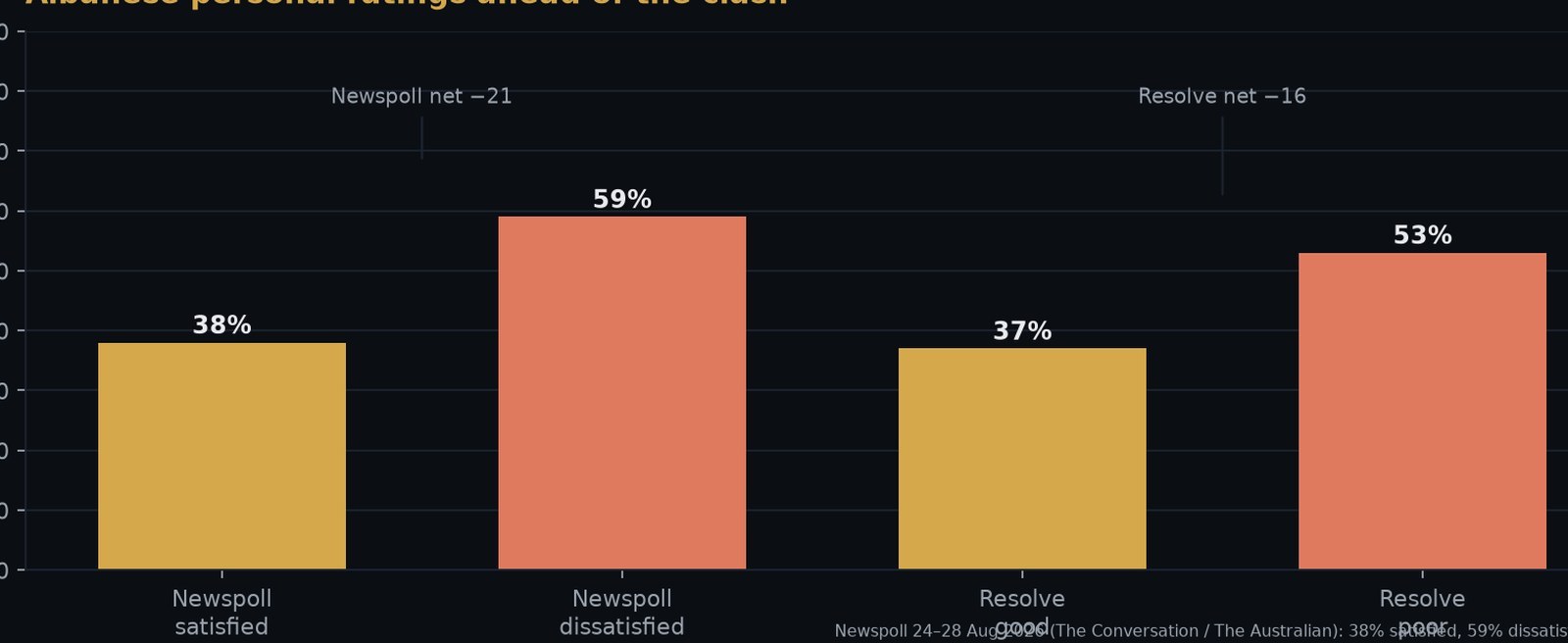
And then there’s Albanese. Thirty-five approve, fifty-six disapprove. Lowest approval as PM. That’s not a primary vote — it’s a job rating — but it sits next to Labor’s primary drop and the “wrong track” number like three instruments playing the same key. A government can lose a primary point and still look stable. Losing five primary points in a month while the PM hits a personal floor is a different kind of week.
The immigration fight Lewis says is driving the churn
Lewis tied the churn to a “messy immigration debate.” He’s not inventing the mess. Over August the three major camps — Labor, Coalition, One Nation — all said they want NOM lower. They did not agree on the number, the baseline, or how you get there. ABC’s Erin Handley filed the explainer on 26 August that every desk has been leaning on since. If you’ve been listening to politicians throw “130,000” and “225,000” and “well below 200,000” around without a glossary, here’s the glossary.
NOM is not “visas issued this year.” It’s arrivals who stay twelve months or more, under the 12/16-month rule, minus long-term departures. Foreign diplomats and their families are out. Returning Australian citizens and New Zealanders moving here are in. That last part matters more than the slogan version of the debate admits. Handley’s numbers for overseas migrant arrivals in 2024–25 included about 64,000 Australian citizen arrivals and about 53,000 New Zealanders. You can cap visas. You can’t cap Australians coming home the same way.
The latest NOM figure Handley cited — released in June — was 300,960 for the year to December 2025. The post-pandemic peak was 556,000 in 2023. The budget forecast has NOM declining to 225,000 from 2027–28. Treasury has missed those forecasts before. Albanese has now called the 225,000-by-2028 figure a target. “We’ve finalised our numbers. We’re headed to 225,000 in two years’ time,” he told ABC Radio Perth. How Labor gets from roughly 301,000 to 225,000 is still the open policy question.

Who’s inside the current NOM? Handley’s 2024–25 visa cohort breakdown is concrete: international students about 156,700; permanent and temporary skilled combined around 86,000; working holiday-makers around 78,000; family about 24,000; humanitarian under 15,000. Students are the biggest visa slice. Humanitarian is the smallest of those listed. That composition is why cutting “migration” without saying which visa class you’re cutting is a slogan, not a plan.
One Nation’s stated target is 130,000 NOM. Pauline Hanson and Barnaby Joyce have both repeated it. The party website says capping visas at 130,000 a year — which, as Handley notes, would not control Australians coming and going visa-free. David Farley’s Insiders appearance muddled the baselines. He put the party’s NOM at 130,000, then talked about PALM workers and aged-care nurses “on top,” and suggested the raw number wasn’t far from Treasury’s 225,000 once you stacked extras. Hanson went to X to restate 130,000. Joyce told News24 the party had reviewed the numbers and was sticking to 130,000. The website line about visa caps and the NOM target are not the same instrument. That gap is part of what Lewis means by messy.
The Coalition hasn’t locked a final number. Taylor’s line on Tuesday, as Handley reported it: NOM “will be set based on the housing supply” and “capped based on how many houses we have,” with an expectation it will be “well below 200,000.” Senator Andrew Bragg floated 180,000 earlier in the month — fewer pastry chefs, more builders — and was counselled for freelancing. Nationals leader Matt Canavan said working holiday visas were off the table for cuts, which matters in regional seats that rely on those workers. So the Coalition’s public position is a housing link, a “well below 200,000” expectation, and an internal reminder not to freelance a precise figure on morning television.
Albanese’s counter is that the other side is throwing numbers “like confetti, with no real plan.” He’s also argued skilled migration matters for aged care, agriculture, and construction — the same construction pipeline the Coalition says should set the cap. That’s the contradiction he wants voters to hear: you can’t demand more houses and then choke the visa classes that supply builders.
What Labor did and didn’t do last week
McIlroy’s Essential piece puts two concrete Labor moves next to the poll. On Friday, Albanese overruled cuts to the annual refugee intake. Separately, broader policy changes expected from Home Affairs Minister Tony Burke have been delayed for weeks. Burke had already postponed a National Press Club address that was meant to outline Labor’s migration settings. The government’s near-term focus, as Handley summarised it, has been keeping temporary visa holders temporary and slowing or pausing processing on some working holiday and skilled visas while the overhaul is finished.
“We have a series of plans in place. There’s more work to do, and we’ll work on that and make announcements at [the] appropriate time,” Albanese said. That’s a holding line. It’s also an admission that the announcement isn’t ready while the debate is already eating primary votes. If Lewis is right that immigration churn is moving people toward both One Nation and the Coalition, then delaying the Burke package doesn’t pause the politics. It just leaves the field to the people shouting numbers.
The refugee-intake overrule is a different kind of signal. Humanitarian visas were already the smallest of Handley’s listed NOM cohorts — under 15,000 in 2024–25. Cutting that intake would not move the national NOM the way cutting students or working holiday numbers would. Overruling the cut tells Labor’s left and refugee advocates the PM won’t use the smallest cohort as a cheap toughness prop. It does not answer the housing-and-students argument that is actually driving the larger NOM fight. Both can be true in the same week.
Secret Harbour as context, not the deep dive
Treat Secret Harbour as prior context. One Nation’s Luke Herdegen won the Western Australian lower-house by-election on Saturday, 29 August 2026. Labor’s Georgia Tree conceded on 30 August. That’s the weekend result. This piece is the Tuesday–Wednesday national poll. The by-election proved One Nation can win a lower-house seat in WA under those local conditions. The Essential survey says the national primary for the same party is 23 percent, down from 28 in May. If you want the booth-level story, it’s already filed on this desk. The new news is the national dial.
Why does that distinction matter for readers outside WA? Because parties campaign as if a by-election is a national verdict. Sometimes it is. Sometimes it’s a local verdict that gets nationalised in the press conference. Essential’s sample is the check on that habit. A party can win a seat and still lose national primary points from a prior peak. That’s what this poll shows for One Nation. A government can watch an opponent win a by-election and still find its own primary is the number falling fastest month-to-month. That’s what this poll shows for Labor.
Albanese’s floor and Taylor’s split
Thirty-five percent approval for a sitting prime minister is a floor worth naming without theatre. Essential has been tracking Albanese through the life of the government. McIlroy reports this as his lowest approval as PM. The disapproval number — 56 percent — means a clear majority of the sample is on the negative side of the job rating. Pair that with Labor’s 26 percent primary and the 59 percent “wrong track” finding, and you have a government that is underwater on mood, underwater on the PM’s job rating, and tied with the Coalition on primary at a level that used to look like a crisis primary for a major party.
Taylor’s 33 approve / 35 disapprove is the other half of the leadership plate. The opposition primary rose. The opposition leader’s net did not soar with it. That pattern usually means voters are parking a protest or a preference shift with the party brand — or with the third party — rather than crowning a replacement prime minister. In a three-way primary world, the opposition can gain without the opposition leader becoming the story. Essential’s numbers fit that reading. They don’t prove it. They fit it.
One Nation doesn’t get a leader-approval callout in the same McIlroy summary the way Albanese and Taylor do. The party’s story in this poll is the primary itself: 23 percent after a by-election win, down from 28 in May. Hanson remains the face of that column. The policy problem McIlroy and Handley both flag is explanation — different baselines for the NOM cut, website language about visa caps that isn’t identical to a NOM target, and the Farley Insiders muddle that Hanson and Joyce had to hose down. Popularity and policy clarity are not the same asset. This month’s poll suggests the first took a hit from the May peak while the second is still being argued in public.
Wrong track, cost of living, and the AI work fear
Lewis’s mood line deserves its own pass because it’s not a primary vote. Fifty-nine percent on the wrong track is the worst since Essential began tracking that question in 2022. Cost of living is the familiar driver. Global uncertainty is the international overlay. The third driver Lewis named — “extremely high levels of concern about the impact of AI on work” — is newer in the Essential framing, and it’s sitting in the same sentence as the immigration churn. That doesn’t make AI the immigration debate. It means the national mood is being pulled by more than one wire at once.
Governments lose elections on cost of living more often than they lose them on abstract technology fear. But when a pollster of Lewis’s seniority puts AI-and-work concern next to cost of living and global uncertainty as a driver of the worst mood reading in four years of tracking, you file it. Labor is already, per McIlroy, considering tougher settings on technology including AI and social media. The political risk is obvious: regulate the feed and the model while the grocery bill is still the thing people feel every Thursday. The political opportunity, if there is one, is showing voters the government heard the work fear as well as the housing fear. Essential doesn’t tell you which way that breaks. It tells you the fear is loud enough to make the mood note.
Social media control, violence, and Contos at the Press Club
The same Guardian Essential package asked about social media and violence against women. More than 70 percent agreed or strongly agreed they want more control over what they see in their social media feed. Four percent disagreed. That’s not a mild lean. That’s a supermajority for more user control, with almost nobody willing to say they want less.
Fifty-five percent believe violence against women has increased in Australia in the past few years. More than two-thirds agreed online content is contributing to violence against women. Sixty-five percent agreed it is “almost impossible” for teenage boys in Australia to avoid seeing damaging content when using the internet. Labor is openly discussing bans on explicit content including sexual strangulation and other violent content. Those aren’t abstract culture-war prompts in this survey. They’re majority positions.
Chanel Contos, founder of Teach Us Consent, was due to address the National Press Club in Canberra on Wednesday calling for opt-in algorithm rules. Her argument, as McIlroy quoted it ahead of the speech: opt-in technology “would fundamentally make the transition on to social media for 16-year-olds and other children safer, and it would bring the principle of affirmative consent to our screens.” And the warning shot at industry self-design: “It is too easy for Big Tech to design schemes that appear as structural reform but actually suit them just fine.”
Put Contos next to the Essential majorities and you get a Wednesday that isn’t only about NOM. The government is fighting a migration argument that Lewis says is moving votes, and it’s also sitting on survey majorities that want harder rules on feeds and violent content. Those are different portfolios. They’re the same news cycle. A night edition that only printed the primary votes would miss half of what Essential actually asked.
Unions at nine percent membership — and still called important
The ACTU is in a leadership transition. Sally McManus is moving on as national secretary; Michele O’Neil’s presidency is part of that broader changeover. Melissa Donnelly, recently national secretary of the Community and Public Sector Union, succeeded McManus as incoming ACTU secretary this week. Essential put union questions into the same fieldwork.
Nine percent of respondents said they are current union members. More people said they belong to a local sporting club (15 percent), a voluntary organisation (11 percent), a church (10 percent), or their favourite professional sporting club (10 percent). Membership is thin. Perceived importance is not. Fifty-six percent said unions are important for working people today; 35 percent said they are not. Nearly 40 percent said workers would be better off if unions were stronger; 30 percent said they would be worse off.
That’s a legitimacy gap, not a membership boom. Donnelly inherits a movement that Essential’s sample still rates as important, and that a plurality wants stronger, while only about one in eleven respondents carries a card. For Labor, which still depends on the union link in its own history and fundraising, the gap is a strategic fact. For the Coalition and One Nation, it’s a different opening: argue that union importance is nostalgia, or argue that workers need something other than the ACTU. The poll doesn’t pick a winner. It measures the gap Donnelly has to close.
How to read a three-point margin
Essential’s margin of error is about three percent. That matters for every comparison you’re tempted to overcook. Labor at 26 and the Coalition at 26 are a tie inside the margin. One Nation at 23 is close enough to the majors that a three-point swing in either direction changes the story you’d tell at a doorstop. Albanese’s 35 approval and Taylor’s 33 approval are not far apart as raw job ratings, even though one is a prime minister on his lowest mark and the other is an opposition leader still slightly underwater on net.
What sits outside a casual shrug: Labor’s five-point drop from 31 to 26 in a month is larger than the margin. One Nation’s five-point drop from the May peak of 28 to 23 is larger than the margin. The Coalition’s rise from 22 in July to 26 now is on the edge of “real move” territory depending how you treat the July baseline. The 59 percent wrong-track number is not a primary-vote horse race; it’s a mood reading with a clear majority on the pessimistic side. The social-media control majority above 70 percent is not a close call.
So the honest read is narrower than a campaign speech and wider than a shrug. The government lost primary ground fast. One Nation lost national primary ground from its May high in the same survey week it was celebrating a by-election. The Coalition gained primary ground without Taylor posting a strong net positive. The immigration debate is the churn story Lewis is selling. The mood is the worst Essential has recorded on that wrong-track series since 2022. And the same sample wants more control over the feed while rating unions important and barely joining them.
What the numbers don’t settle
A mid-cycle Essential poll is not an election. Preferential counting, seat geography, and candidate quality still decide who wakes up as prime minister. A 26–26–23 primary world would produce very different House maths depending on where those One Nation votes preference and which seats they concentrate in. This survey doesn’t publish a seat map. It publishes national primaries, leader ratings, mood, and issue batteries.
It also doesn’t settle the NOM policy fight. Labor has a 225,000-by-2028 target and a delayed Burke package. The Coalition has a housing link and a “well below 200,000” expectation without a final locked number. One Nation has 130,000 with a public explanation problem about baselines and visa caps. Albanese overruled refugee-intake cuts on Friday. None of that is resolved by a thousand-person sample. The sample only tells you the politics of that mess are already moving votes.
You might want a single villain or a single rescue. Essential didn’t provide one. It provided a three-way primary, a PM on his lowest approval as PM, an opposition leader split down the middle, a protest party off its May peak after a by-election win, a national mood at a series low, and a set of social and union questions that sit beside the horse race instead of inside it.
Students, backpackers, and the NOM you can’t slogan away
Return to Handley’s cohort list for a minute, because the political argument keeps collapsing three different problems into one word. International students at about 156,700 in the 2024–25 NOM contribution are not the same policy lever as working holiday-makers at about 78,000, or skilled at about 86,000, or family at 24,000, or humanitarian under 15,000. A speech that says “cut migration” without naming the class is asking voters to hear toughness. A budget that has to hit 225,000 has to name the class, or miss the target again.
Students are the largest visa slice in that breakdown. They’re also tied to university budgets, regional campuses, and rental demand in the cities where the housing argument is loudest. Cut students hard and you move NOM. You also move revenue and local labour in sectors that hired those graduates and part-time workers. Keep students high and you keep the housing pressure argument alive for One Nation and the Coalition. That’s why Bragg’s “fewer pastry chefs, more builders” line travelled — it tried to sound like a skilled-mix fix — and why Canavan’s defence of working holiday visas travelled in the other direction for regional employers. Same NOM debate. Different electorates inside it.
Working holiday-makers sit near 78,000 in Handley’s figures. They’re often described as backpackers. In regional horticulture and tourism they’re a labour pipe. Canavan’s refusal to put that pipe on the cut list is a Nationals identity move as much as a migration move. Taylor’s housing-linked cap has to live with that internal limit. If the Coalition’s “well below 200,000” path can’t touch backpackers and is cautious on builders, the cut has to fall somewhere else — students, graduates, or other skilled subclasses. The party hasn’t published that table. Essential’s voters are still being asked to choose a mood about migration without the table.
Then there’s the part of NOM that isn’t a visa class at all. Sixty-four thousand Australian citizen arrivals. Fifty-three thousand New Zealanders. Together that’s more than 110,000 people in the arrival story before you argue about a student visa. Hanson can put 130,000 on a lectern. Joyce can say the party reviewed the numbers. The website can talk about capping visas at 130,000. Australians coming home still land in NOM under the 12/16 rule. Farley tried to say that out loud on Insiders and tangled the extras. The tangle doesn’t make the citizen-return point false. It makes the 130,000 slogan harder to audit.
PALM workers are the other footnote politicians keep tripping on. Short Pacific placements under nine months can sit outside NOM. Longer placements can sit inside it. Joyce told people to ignore PALM counts that don’t meet the twelve-month test. Farley talked about stacking PALM and aged-care numbers “on top” of 130,000. Those are not compatible explanations if you’re trying to tell a voter what the country’s net migration will be under One Nation. They’re compatible with a party still translating a slogan into an admin manual.
Burke’s delay and the cost of an empty podium
Home Affairs was supposed to own the detailed answer. Burke’s postponed Press Club speech was the slot where Labor could have replaced confetti with a grid: which visas slow, which stay, how temporary stays temporary, what enforcement looks like when someone overstays the story they told the department. Instead the slot slipped, the overhaul slipped “for weeks,” and Albanese’s radio line about finalised numbers to 225,000 had to carry the load without the grid beneath it.
Processing pauses on working holiday and skilled streams are a real lever. They’re also invisible to most voters unless someone explains them. A Press Club speech is where you explain them. Without it, the public argument defaults to the loudest round number in the room. One Nation’s 130,000 is louder than a processing pause. Taylor’s “well below 200,000” is louder than a timeline. Labor’s 225,000 is a Treasury-shaped target that still needs a mechanism chapter. Essential’s churn finding is what happens when the mechanism chapter is late and the slogans are early.
Albanese’s Friday overrule on refugee-intake cuts fits the same communications problem from another angle. On the numbers, humanitarian is already the small cohort. On the politics, overruling a cut is a values signal to one part of the Labor base and a toughness deficit to voters who want every intake line pointed down. McIlroy places that overrule in the same piece as the primary drop. He doesn’t claim it caused the drop. He places it in the week. Readers can do the rest without a novelised Cabinet leak.
Three parties, three unfinished plans
Strip the rhetoric and you get three unfinished plans on the same metric.
Labor: 225,000 NOM by 2028 as a stated target; temporary-visa discipline as the near-term method; Burke package delayed; refugee-intake cut overruled; skilled migration defended for care, farms, and building.
Coalition: housing completions as the governor; Taylor’s expectation of well below 200,000; Bragg’s 180,000 trial balloon counselled; Canavan protecting working holiday visas; no final public table yet.
One Nation: 130,000 NOM as the repeated Hanson/Joyce figure; website language about capping visas at 130,000; Insiders confusion about extras and baselines; a deleted earlier social post that had mixed arrivals, departures, and a negative NOM example, as Handley reported.
Albanese’s “confetti” insult lands because unfinished plans invite confetti. It lands less well when your own unfinished plan is the one Essential says voters are leaving. You can be right that the other parties lack a mechanism and still lose primary points while you lack a finished mechanism of your own. This poll is comfortable with that double.
Why 26–26–23 is a different politics
Australian federal elections are still decided on preferences and seats, not on who wins the national primary beauty contest. That sentence is true every cycle. It’s doing more work in a 26–26–23 world than in a 40–35 world. When two majors sit in the mid-twenties and a third party sits at 23, preference negotiations, how-to-vote cards, and the geography of One Nation’s vote stop being boutique concerns. They become the maths.
Essential doesn’t hand you that maths. It hands you the warning light. A party on 23 percent nationally is not guaranteed 23 percent in any given division. It might run hotter in regions where NOM and housing arguments dominate, and colder in seats where those arguments don’t. Secret Harbour was one data point on the hot side. A national sample averaging 23 is the cooler national mean after May’s 28. Campaign professionals will spend the next fortnight arguing which number is the “real” One Nation. Both are real. They measure different things.
For Labor, a 26 primary with a PM on 35 approval is a governing problem before it’s a preference problem. Governments can harvest preferences and still look terminal if the primary sinks and the mood stays wrong-track. For the Coalition, a 26 primary with a leader at 33/35 is an opportunity with a ceiling: the party is recovering share without a dominant personal alternative to Albanese in this survey. For One Nation, 23 after Secret Harbour is both a historic high relative to the party’s long-run federal averages and a retreat from May. How Hanson talks about that retreat will shape whether 23 feels like a platform or a warning.
The social majority waiting on legislation
Return to the feed numbers, because they may outlast the week’s NOM argument. More than seventy percent want more control over what appears in the social media feed. Four percent disagree. Contos’s opt-in algorithm demand is an attempt to turn that majority into a design rule: default off for algorithmic amplification until a user opts in, especially around the sixteen-year-old entry point Labor has already been wrestling with in the social-media age debate.
The violence findings sit beside that design argument. Fifty-five percent say violence against women has increased. More than two-thirds tie online content to that violence. Sixty-five percent say teenage boys can’t avoid damaging content. Labor’s discussion of banning explicit content such as sexual strangulation is a content-side answer. Contos’s opt-in rules are a systems-side answer. Essential suggests both answers have an audience. Neither is the immigration debate. Both are in the same fieldwork that recorded Labor’s primary slide.
That’s inconvenient for a news cycle that wants one spine. It’s accurate to the questionnaire. A government answering only NOM while a supermajority asks for feed control is leaving a second ballot on the table. A government answering only feeds while NOM churns primary votes is leaving the first ballot on the table. Lewis named immigration as the churn story for the party primaries. He named cost of living, global uncertainty, and AI-on-work as the mood drivers. The social-media block is additional pressure, not a substitute spine.
Donnelly’s first week under a thin-membership poll
Melissa Donnelly takes the ACTU job in a week when Essential says nine percent of people are union members and 56 percent still call unions important. That gap is the job description. McManus spent years as the public face of a movement whose membership density no longer matches its claimed social role. Donnelly arrives from the CPSU with a public-sector organising background into a national role that has to speak to private-sector workers who, in this sample, are more likely to be in a footy club than a union.
Nearly 40 percent say workers would be better off if unions were stronger. Thirty percent say worse off. The rest are uncommitted or elsewhere. That’s a contestable plurality, not a consensus. If Donnelly can convert “important” into membership and bargaining coverage, Essential’s legitimacy gap narrows. If she can’t, parties that run against union power will keep citing the nine percent, and parties that run with union power will keep citing the 56 percent. Same poll. Opposite speeches.
For the Albanese government the union numbers are a reminder that Labor’s institutional allies are popular in theory and narrow in fact. For Taylor they’re a reminder that anti-union politics still has a 30 percent bloc that thinks stronger unions make workers worse off — useful, not decisive. For One Nation, which often pitches straight past institutions to “ordinary Australians,” thin union membership is terrain, not a headline.
The week’s shape for Adelaide readers
For a Wednesday night edition in Adelaide, the practical question is what changed since the weekend. Saturday was Secret Harbour. Sunday and Monday were the rhetoric fight in Queensland and Canberra — Albanese and Chalmers at the Queensland Labor conference, Hanson answering, Rowland telling Hanson to look inward. That’s already on the record. Tuesday’s Essential release, published into Wednesday’s papers and feeds under McIlroy’s byline, is the national measurement after those days.
Labor at 26. Coalition at 26. One Nation at 23. Albanese at 35 approve / 56 disapprove. Taylor at 33 / 35. Wrong track at 59. NOM still the policy argument without a shared baseline. Contos at the Press Club on opt-in algorithms the same Wednesday the poll is being digested. Donnelly taking the ACTU job while Essential finds nine percent membership and 56 percent saying unions still matter.
That’s the plate. Not a prediction. A measurement. The national primary moved — away from Labor over the month, away from One Nation’s May peak, toward a Coalition recovery that still leaves Taylor underwater on net. The immigration debate Lewis named is the churn story. Cost of living, global uncertainty, and AI-and-work fear are the mood story. The feed-control majorities are the social story filed in the same package.
If you’re waiting for one number to explain the week, you won’t get it. You’ll get the cluster: a by-election win, a national slip for the winner’s party from its peak, a government’s sharpest recent primary drop, a PM on his lowest approval as PM, and a migration argument that still can’t agree what 130,000 and 225,000 even mean. Essential measured the cluster. The parties still have to govern inside it.
The paper
Comments
No notes on this story yet.
Sign in to comment