This is the tape of Wednesday's Vandenberg Starlink, not the booster ledger. SpaceX, Spaceflight Now, and NASASpaceflight have webcasts of Group 15-23 from Space Launch Complex 4E: a Falcon 9 Block 5, about 08:42 UTC, 1:42 a.m. Pacific, twenty-seven V2 Minis aimed at Of Course I Still Love You.
Landing is not confirmed. Spaceflight Now, Next Spaceflight, SpaceX, and NASASpaceflight still had the droneship as a target when this copy closed, not a touchdown. If you want the pictures — livestream, landing burn, deck, legs, replay — the streams are the file.
Where do you actually press play? SpaceX's mission page, spacex.com/launches/sl-15-23, is the company tape. The sentence there is plain: "A live webcast of this mission will begin about 10 minutes prior to liftoff, which you can watch here and on X @SpaceX." KEYT's Vandenberg desk, Andrew Gillies on 1 September, said the same ten-minute start, on the company site or on SpaceX's X account. Spaceflight Now's Steven Young preview, also 1 September, promised that desk's own live coverage: "Spaceflight Now will have live coverage starting 30 minutes prior to launch." NASASpaceflight titled its stream SpaceX Launches Falcon 9 Starlink 15-23 from Vandenberg. Space Affairs titled theirs GO! — SpaceX — Falcon 9 — Starlink 15-23 — SLC-4E — Vandenberg SFB, CA — Space Affairs Live. Four doors. One south-easterly night.
Came in after T-0? The replay keys are ordinary YouTube objects. Spaceflight Now is bwGo6lIW3rQ. NASASpaceflight is msp_aXGeB0I. Space Affairs is C2M8CpEjHJk. The company page and X @SpaceX are the official feed. Same pictures, different rooms. Play whichever is already in the house. Those identifiers stay after the morning is over. That is what a replay is.
The shot list is SpaceX's own timeline, not a scene I'm inventing. Max Q at T+1:08. Main-engine cutoff at T+2:25. Stage separation at T+2:29. Second-stage start at T+2:36. Fairing gone at T+2:57. First-stage entry burn T+6:01 to T+6:25. Landing burn begins T+8:01. Landing is listed at T+8:24. Second-stage cutoff T+8:38. The satellites, if the hour holds, come off at T+1:02:04. That last line is not the tape. The tape is the eight-minute return to a ship.
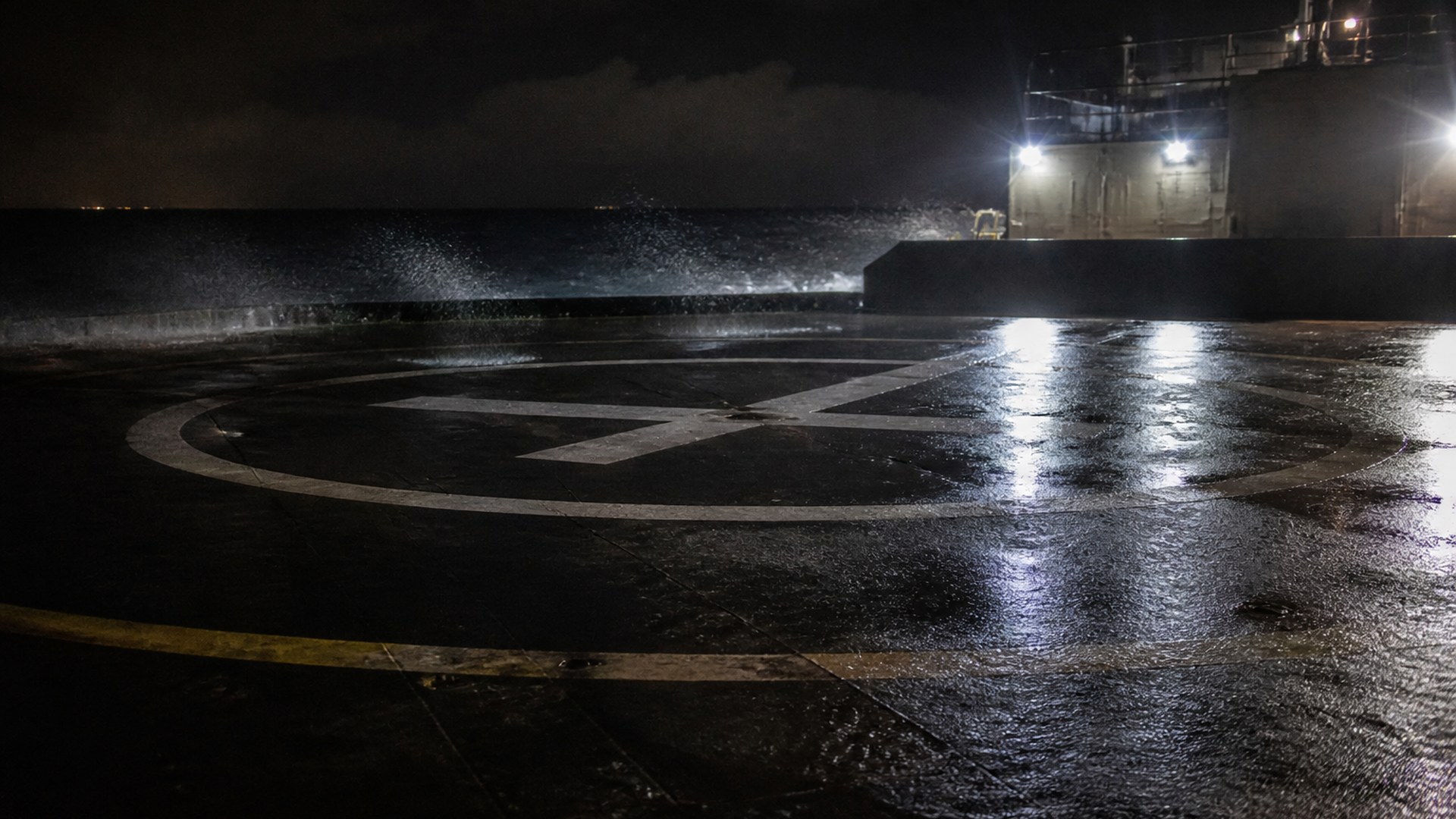
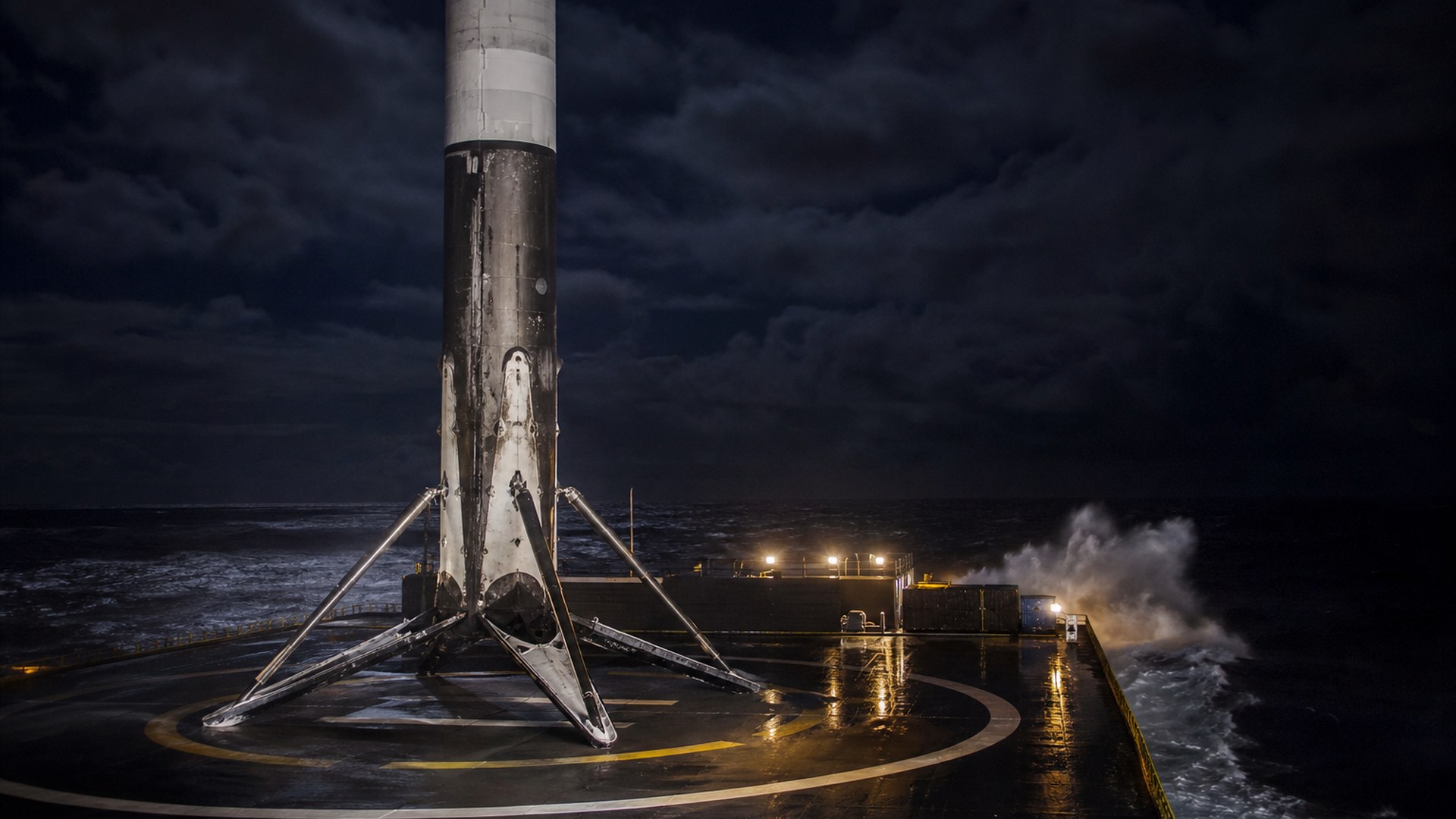
Landing burn. Deck. Legs. That is the picture the company put on the clock. Quote SpaceX, still in the future tense: "Following stage separation, the first stage will land on the Of Course I Still Love You droneship, which will be stationed in the Pacific Ocean." I'm keeping the tense. Spaceflight Now stationed the same ship off Baja California. Next Spaceflight still had Of Course I Still Love You as the recovery, B1063 on its 35th flight, a 29-day turnaround, and called it the 675th Falcon recovery attempt. Space Launch Live, syncing Wednesday, still tagged the droneship PLANNED. Planned is not past. I'm not writing the sit-down until one of those four sources does.
Of Course I Still Love You is the camera platform. Pacific droneship, Culture name, painted deck. Space Launch Schedule's note on the vessel is the history, not this morning: second autonomous spaceport droneship, West Coast water, and the site of SpaceX's first Falcon 9 first-stage landing, CRS-8. A first stage that is asked to come home at sea does it on legs. Four of them. That is the machine. I did not stand on that deck and will not narrate a flame or a face. The webcast is how a household sees a barge without a boat. If the timeline holds, the landing burn is the shot at eight minutes. If it doesn't, the same stream is still the record of the attempt.
The clock moved, which is why the webcast start is a relative. Next Spaceflight's window is 07:46 to 11:46 UTC — 12:46 a.m. to 4:46 a.m. Pacific, the same window KSBY printed. Space Launch Live logged the slips: 07:46, then 08:18, then 08:42, and a GO at 08:31 UTC. Spaceflight Now's preview put T-0 at 1:42 a.m. Pacific, 08:42 UTC. That desk's schedule page, updated 1 September, later listed 1:18 a.m. Pacific, 08:14 UTC. I'm using 08:42 as the company-and-tracker minute and 08:14 as the other published clock. Streams that start at T-10 or T-30 move with whichever minute actually lights. In Adelaide, 08:42 UTC is 6:12 p.m. The landing burn, on that clock, is about 6:20 p.m. Deployment, if you stay, is about 7:14 p.m.
Local audio is not the tape, and the California desks do not even agree on the boom. The Santa Maria Times, a 1 September Lompoc Record staff report citing base officials, said residents of Santa Barbara, San Luis Obispo, and Ventura counties may hear one or more sonic booms depending on weather and other conditions. KEYT said the same. KSBY's Kathrene Herndon, filing for the immediate viewing area, said no sonic boom was expected to be heard locally, and called Wednesday the 60th launch from Vandenberg this year. Print both. I'm not inventing a window rattling in a kitchen I have not entered. The pictures are downrange, on a ship, on a stream.
The booster file is already on the paper. B1063, thirty-fifth flight, delayed from 1 September, twenty-seven V2 Minis. That is a numbers piece. This is not a recut of it. SpaceX named the prior work on the mission page: Sentinel-6 Michael Freilich, DART, Transporter-7, Iridium OneWeb, SDA-0B, NROL-113, NROL-167, NROL-149, NAOS, and 25 Starlink missions. KEYT counted 24 prior Starlink missions on the same list of names. The Times kept SpaceX's 25. The flight number both desks agree on is 35. You do not need that census to find the landing-burn shot. You need a URL and eight minutes.
Stay for the hour if you want the dishes. SpaceX lists a second-stage restart at T+53:12, cutoff a second later, and Starlink deploy at T+1:02:04. Spaceflight Now's preview said 27 Starlink V2 Mini satellites would come off the upper stage just over an hour into flight, if the plan held. A lot of company webcasts ease off after the landing. That is ordinary. The replay does not. You can scrub to T+8:01 later and still have the burn. You can scrub to T+8:24 and see whether the company, or Spaceflight Now, or NASASpaceflight, then uses the past tense. I'm not taking that early.
The U.S. Space Force approved the attempt. The Santa Maria Times said so, and named Space Launch Complex 4 East. The rocket in the frame is a Falcon 9 Block 5. Pad 4E sits on Vandenberg Space Force Base in Santa Barbara County. Space Launch Delta 30 is the unit on the base. South-east over water. After T+6 the cameras that matter are not the pad. They are the ones looking at a booster coming back to a deck.
The streams are up. The ship has a name. The burn has a time. A West Coast Starlink night is now the working picture of how this constellation still grows on Falcon 9, and the household tool for that picture is a webcast, not a press badge. SpaceX at T-10. Spaceflight Now at T-30, bwGo6lIW3rQ. NASASpaceflight, msp_aXGeB0I. Space Affairs, C2M8CpEjHJk. Company page sl-15-23, and X @SpaceX. Landing burn at T+8:01 if the timeline holds. Deck and legs if the ship takes it. Replay on the same objects. That is the video file. Play it. Then read the ledger beside it.
The paper
Comments
No notes on this story yet.
Sign in to comment