
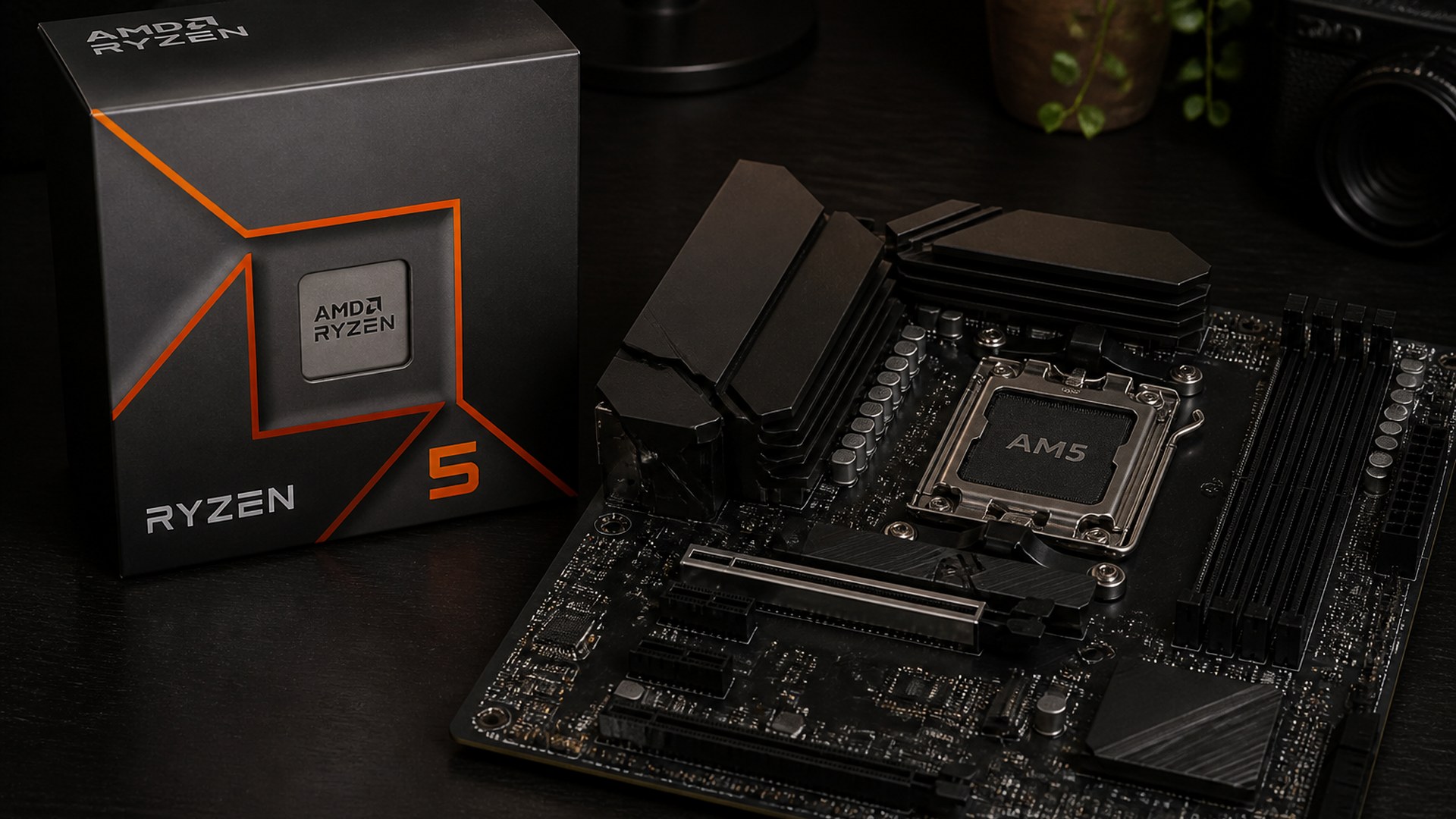
Zen 6 stays on AM5. That's AMD's own paperwork, not a leaker with a slide. Hardware tracker InstLatX64 captured an AMD Technical Information Portal listing on 26 August that maps the Zen 6 consumer families Olympic Ridge and Medusa1 to socket AM5, with Medusa1 and Medusa2 on the mobile FP10 package.
AMD already said at Computex 2026 that AM5 support runs through at least 2029. The portal line is the first time the company's own docs named the next desktop generation against that socket. It is not a launch date. AMD has not confirmed when Olympic Ridge or Medusa1 go on sale.
The object is a filter on a documentation site AMD runs. InstLatX64 posted the mapping from docs.amd.com: Medusa1 is FP10 and AM5. Medusa2 is FP10. Olympic Ridge is AM5. VideoCardz filed it on 26 August. Wccftech's Hassan Mujtaba put a 26 August 06:50 a.m. Eastern stamp on the same tables. Igor's Lab followed. XenoSpectrum transcribed the portal categories: AMD Ryzen Desktop, Olympic Ridge, AM5; AMD Ryzen Desktop, Medusa1, AM5; AMD Ryzen Mobile, Medusa1, FP10; AMD Ryzen Mobile, Medusa2, FP10. That four-line grid is the news. A keynote is not.
Family IDs sit in the same paperwork. VideoCardz, reading InstLatX64, listed Medusa1 as Family 1Ah, models 80h through 87h. Olympic Ridge as models 88h through 8Fh. Medusa2 as models E0h through E3h. Those hex ranges are how AMD's own docs tell a BIOS author which silicon belongs on which package. They are not a SKU list. AMD has not announced a Ryzen model number for Olympic Ridge. It has not put a boxed Medusa1 on a store page. The socket name is the confirmation. The shopping list is not.
Want a date? AMD did not give you one. The working press expectation is a CES 2027 unveil and availability in the first half of 2027. Wccftech wrote that expectation on the same 26 August file and was careful to mark it as expected. I'll mark it the same way. AMD has not confirmed a consumer launch date for Zen 6 desktops. Anyone selling you a month is selling a rumour.
Core counts are the other rumour that wants to climb into the lede. They do not belong there. Previous leaks, which VideoCardz recapped, have suggested up to 12 Zen 6 cores per CCD and desktop configurations from 6 to 24 cores. Wccftech's comparison table put "24/48 (TBA)" on a hypothetical Ryzen 10K line and "2nm" in the process column. Those numbers are labelled rumour here, because AMD's portal listing does not state them. Up to 24 desktop cores, 12 per CCD, is rumour. It is not an AMD fact. If you need a core count you can stand on, wait for a slide AMD puts its logo under.
What AMD has already put into commercial silicon is the server side. EPYC Venice, the 6th Gen EPYC line, is Zen 6 in the data center. AMD formally debuted it at Advancing AI 2026 in San Francisco on 22 and 23 July. Outlets covering that event reported AMD's top Venice configuration at 256 cores, TSMC's 2-nanometre process, and a production ramp. VideoCardz later had EPYC 9006 SP7 systems scheduled to ship in the fourth quarter of 2026, with the rest of the 9006 stack through 2027. The consumer families on AM5 are not that product. Venice is the proof that Zen 6 is not a 2028 abstraction. Olympic Ridge is still a socket line in a portal.
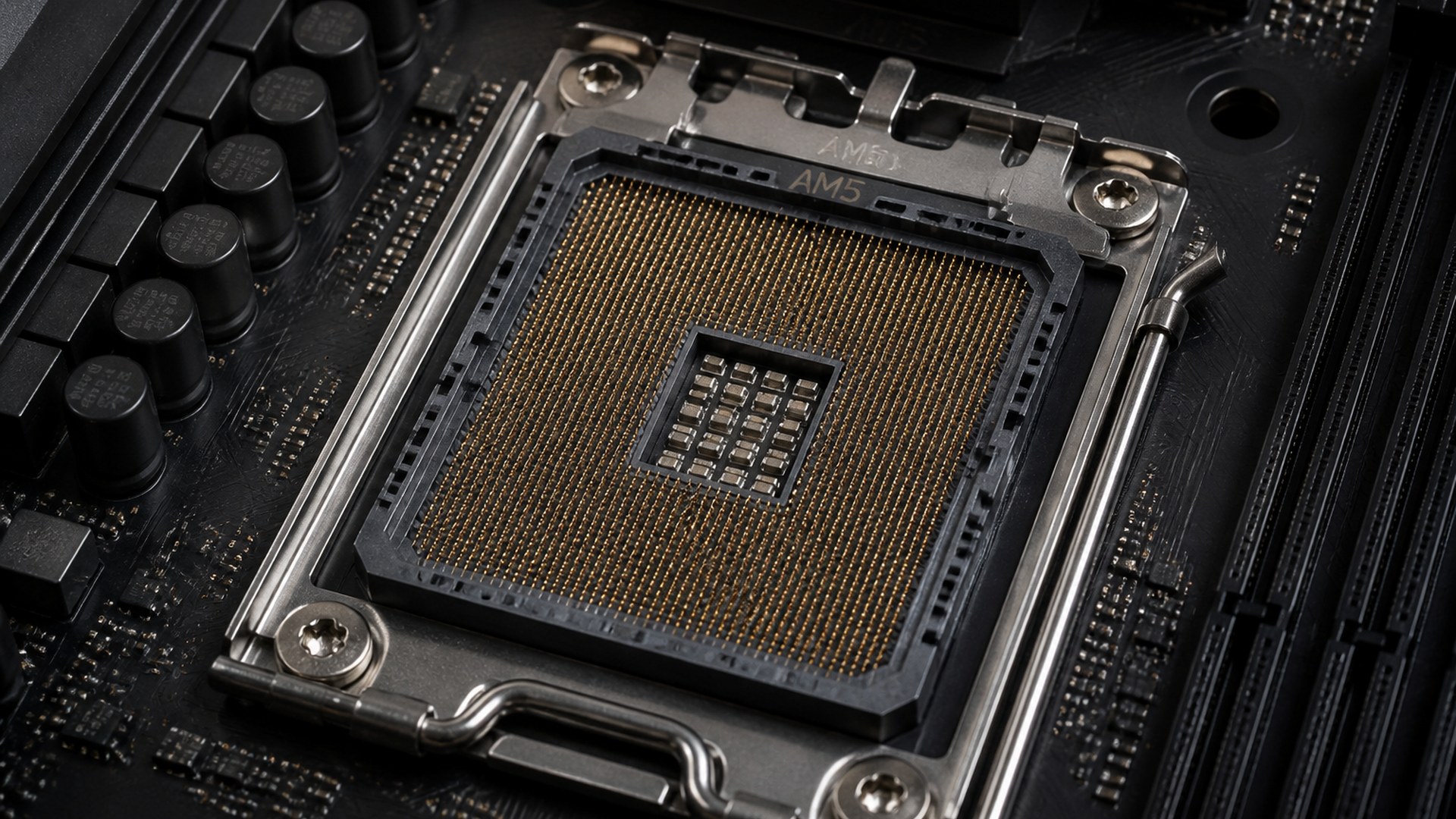
AM5 itself is not new. AMD launched the socket in September 2022 with Ryzen 7000, the Zen 4 desktop parts known as Raphael. It is an LGA socket, 1,718 contacts, DDR5 only. Ryzen 8000G APUs and Ryzen 9000, the Zen 5 Granite Ridge desktops, already live on it. The original 2022 pledge was support until at least 2025. Computex 2024 stretched that to 2027 and beyond. Computex 2026, at the end of May, stretched it again: support through 2029. AMD's own Computex blog put the sentence in public: the company "confirmed extended support for Socket AM5 through 2029." That commitment was a date. It was not a named CPU family. 26 August named the families.
Medusa1 is the interesting row, if you live on this socket. Olympic Ridge was the expected chiplet desktop. Medusa1 listed against both AM5 and FP10 means AMD is preparing a socketed version of a design that also goes into notebooks. VideoCardz read that as a desktop APU beside the chiplet CPU, the same shape as Ryzen 9000 next to Ryzen 8000G today. Medusa2, in the same capture, stays on FP10. A smaller mobile part. No AM5 line beside it. That is not a product stack AMD has priced. It is a package map.
Will your current AM5 board take Olympic Ridge? The portal does not promise that. VideoCardz was explicit: this does not confirm individual Ryzen models or motherboard compatibility. Support for existing boards still depends on motherboard vendors and BIOS updates, which means an AGESA drop, flash space, and whether a three-year-old B650 gets the same attention as a current X870E. A socket name in a doc is not a microcode file on your USB stick. Patient is the right speed. The pins are the same family. The firmware is a later sentence.
Intel's desktop next-act is a different socket. LGA1954 already sits next to NVL-S on Intel's Design-In Tools store. Nova Lake-S does not drop into today's LGA1851 boards. AMD is doing the opposite thing on the consumer side: keeping the socket, putting the next architecture on it, and saying so in its own technical portal. That is the comparison that matters if you bought an AM5 board in 2023 and have been staring at DDR5 prices. You are not being told to throw the board away in 2026. You are being told Zen 6 is on the pinout. The month you can buy the chip is still unlisted.
XenoSpectrum added a useful caution on 27 August. AMD's public search, logged out, no longer showed the filter items in the screenshot. The capture is the document. Documents get edited. InstLatX64's 26 August grab, and the family-model table that went with it, are what the press could read. If AMD wanted those names off the public internet, it still put them in a portal long enough for the socket mapping to be copied. That is how a confirmation looks in 2026. Not a keynote. A table.
So here is the board you can actually write down. Olympic Ridge: Zen 6 desktop family, AM5, Family 1Ah models 88h-8Fh. Medusa1: Zen 6, AM5 and FP10, models 80h-87h. Medusa2: FP10 only, models E0h-E3h. AM5 support through 2029, per AMD at Computex. EPYC Venice already commercial as server Zen 6. Consumer launch date: not confirmed. CES 2027 and first-half 2027: press expectation, not an AMD date. Up to 24 desktop cores and 12 per CCD: rumour. The socket stays. The chip has a name. The calendar does not.
The paper
Comments
No notes on this story yet.
Sign in to comment