
NASA just handed Blue Origin the Mars radio. The agency announced on Tuesday, 1 September, that it awarded Blue Origin a firm-fixed-price contract, maximum potential value about US$700 million, to develop the Mars Telecommunications Network.
The job is a high-performance Mars telecom orbiter, delivered to NASA no later than 31 December 2028. NASA expects operations at Mars by 2030. Blue Origin designs, develops, integrates, launches, and operates. That's the whole chain, in NASA's own release.
Contract release C26-010 is the document. Jessica Taveau dated it 1 September 2026 out of NASA Headquarters. The first paragraph does the work: NASA awarded Blue Origin a contract Tuesday to develop the agency's Mars Telecommunications Network, "a next-generation communications system that will enable reliable, high-bandwidth communications and navigation services for current and future Mars missions." The second paragraph is the money and the clock. Firm-fixed-price. Maximum potential value of approximately $700 million. Deliver a high-performance Mars telecommunications orbiter to NASA no later than 31 December 2028.

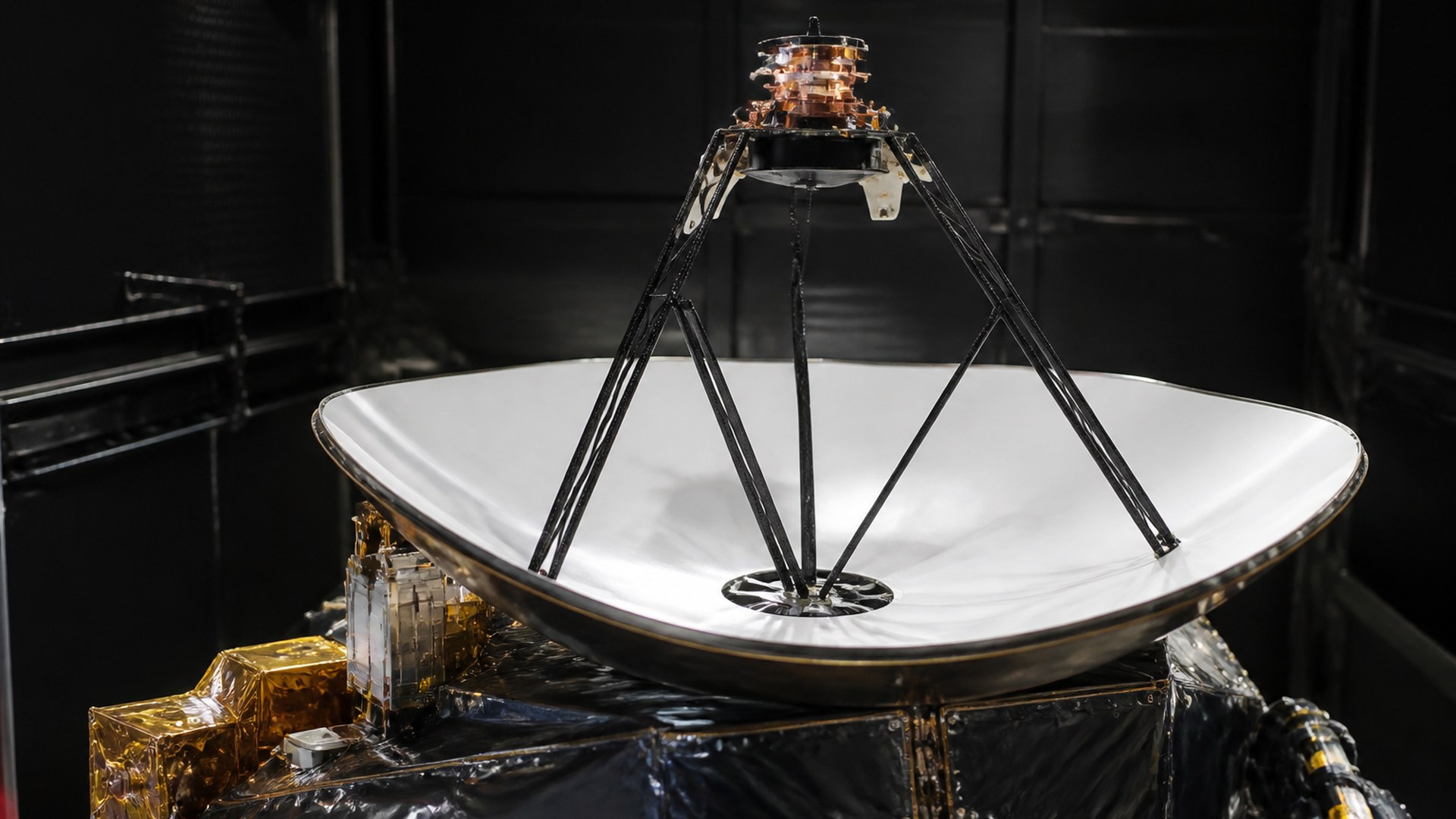
Seven hundred million dollars. What does NASA actually buy? Not a study. Not a slide. Blue Origin will "design, develop, integrate, launch, and operate the network as a part of the agency's broader space communications and navigation infrastructure." NASA's sentence, not a paraphrase from a contractor blog. The architecture, the release says, will consist of a high-performance telecommunications spacecraft orbiting Mars, transmitting "science data, imagery, navigation information, and critical mission communications for spacecraft operating on and around the planet."
SCaN holds the file. NASA's Space Communications and Navigation program manages the network. The same shop runs the Deep Space Network: three antenna complexes about 120 degrees apart, in California, Spain, and Australia. The May request for proposals already placed this work inside SCaN's Moon to Mars strategy. Tuesday's award is the contractor name on that line. Blue Origin. Kent, Washington. The company that already flies New Glenn and builds lunar landers. This contract is the Mars radio, not a lander.
The request for proposals went out in May. NASA's 14 May page, "NASA Draws on Industry for Mars Telecommunications Network," is the primary for that step. Lauren E. Low filed it. Thursday, NASA issued the RFP. It built on a draft released 2 April and on an industry day at Goddard Space Flight Center in Greenbelt, Maryland. Industry had 30 calendar days to respond. The network, that page said, should be ready to operate at Mars no later than 2030. Tuesday's award kept that 2030 operations line and added the hard delivery date of 31 December 2028 for the orbiter itself.
Congress put money and a date on the work before the RFP. NASA's May page said the network is enabled by direction and funding in the Working Families Tax Cut Act. The SAM.gov synopsis for the procurement pointed at Public Law 119-21, signed 4 July 2025, which added 51 U.S.C. §20306 and called for a competitively bid, firm-fixed-price contract with a United States commercial provider for a high-performance Mars telecommunications orbiter. NASA did not invent the ceiling. The statute and the award both sit near US$700 million.
Why a dedicated orbiter, and why now? The Mars Relay Network is four spacecraft that already ferry rover data while doing their own science. NASA's Mars page names them. Mars Odyssey, at Mars since 2001, flies 385 to 450 kilometres up and averaged 107.3 megabits a day of relay in February through May 2026. Mars Reconnaissance Orbiter, listed by NASA with a 2005 arrival, flies 255 to 320 kilometres up; 850.6 megabits a day in that same window. ESA's Mars Express is listed as backup. ESA's ExoMars Trace Gas Orbiter, at about 400 kilometres, carried the heavy end: 2,228.1 megabits a day. Those are NASA's table, not a press-kit round number.
MAVEN is no longer in that table as a live relay. NASA declared the mission at an end on 3 June 2026 after the spacecraft went silent on 6 December 2025 and a review board judged it unrecoverable. SpaceNews had Jeff Foust on that declaration the same day. NASA's own relay page says other orbiters picked up the slack. Greg Heckler, deputy program manager for capability development in SCaN, told SpaceNews there had been some small adjustments to rover operations but no "science deficit." He also said there is an "urgency" in getting the Mars Telecommunications Network in service.
The surface is why the radio matters. Curiosity and Perseverance still work on Mars. Rovers lack line-of-sight to Earth for about 12 hours a day because the planet rotates. Earth-Mars distance runs from 54.6 million kilometres, about three minutes of light time, to 400.2 million kilometres, about 22.4 minutes, NASA's figures. Direct-to-Earth from a rover is possible. It is slow. The relay orbiters talk to the rovers at up to 2 megabits a second, then throw the bits across interplanetary space with bigger antennas and more power. NASA's page is plain: every image seen from the surface of Mars since 2004 has come through the Mars Relay Network. When Perseverance landed at Jezero Crater in 2021, MRO took the entry, descent, and landing data in real time and sent it home.
The May RFP asked industry to address current and future operational missions. It also asked for a science-payload accommodation that NASA's Science Mission Directorate would select. Tuesday's award release does not name that payload, and I'm not inventing one. It names the orbiter, the operator, the date, and the dollar ceiling. Rob Margetta at Headquarters and Rob Garner at Goddard are the contacts on C26-010.
Firm-fixed-price is the contract type, not a slogan. NASA set a ceiling and put design through operations on Blue Origin. Delivery no later than 31 December 2028 is a calendar date, not a "late 2020s" shrug. Operations at Mars by 2030 is NASA's expectation, not a Blue Origin launch-window tweet. The gap between those two dates is transit, checkout, and turning a delivered spacecraft into a working network. NASA did not publish a launch vehicle in the award. I'm not picking one for them.
Artemis is the backdrop NASA wrote into the release, not the payload. "Under the Artemis program, NASA is sending astronauts to explore the Moon and prepare for missions to Mars." Robotic missions, the agency said, will pave the way, and as they expand, demand for data will keep rising. That is why NASA wants a purpose-built network with more capacity, reliability, and operational flexibility than a handful of aging science orbiters doing relay on the side. Tuesday is the contractor selection. It is not a signal from Mars.
Blue Origin now has a Mars communications job with a published ceiling and a published delivery date. NASA has a named commercial provider for the radio it said it needed. The orbiters already at Mars keep working. The new one is due in NASA's hands by the last day of 2028, with the agency expecting it on station by 2030. That is the file.
The paper
Comments
No notes on this story yet.
Sign in to comment